

The automotive world is in the middle of a huge technological transformation, and that extends into the showroom. With new vehicles coming into business, the finer points of selling, servicing, and representing them have become more complex.
The industry may have transitioned to digital forms. Still, the fundamental problem has not gone away: How do we make decisions from a mountain of inspection data to inform actions that will drive performance improvements on the ground? This fundamental inequality is now being dramatically altered by artificial intelligence. While AI in dealership management is honed in labs and whitepapers, it’s no longer an abstract concept; OEMs and dealer networks today can quickly integrate automation directly into how they design, implement, and operationalise audit findings.
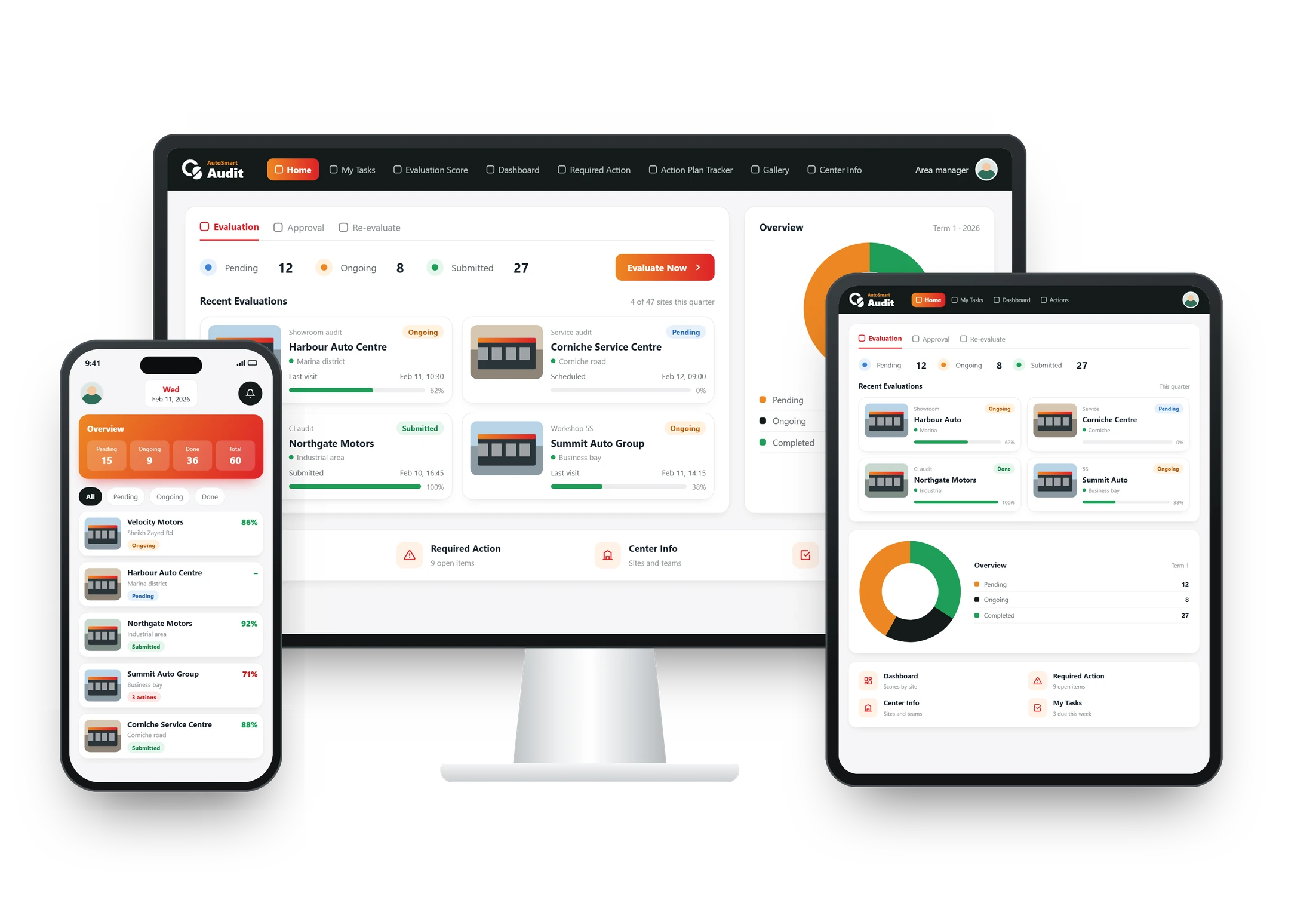
With AI, the automotive industry is no longer focusing on reacting to problems but instead proactively creating excellence based on data. Platforms like Autosmart Audit harness machine learning, computer vision, and predictive analytics to not only automate monotonous inspection tasks but also provide insights hidden under piles of paperwork.
How Does Artificial Intelligence Transform Dealership Audit Lifecycle and Real-Life Use Cases?
Powered by Artificial Intelligence, the dealership audit lifecycle shifts a static, time-bound event into a dynamic, continuous cycle of improvement. At Autosmart Audit, in our audit management software, we use AI on the platform to automate data validation, predict risks, and reduce the time from issue identification to resolution, a true testament to AI in dealership management.
- Pre-Audit: Predictive Risk Assessment
Rather than subjecting all dealerships to the same audit schedule, AI considers past performance data, staff turnover rates, and historical compliance failures. That way, the platform can identify high-risk locations that may be entering a state of incompliance so managers can prioritize inspections where they matter most.
- On-the-fly Validation: Computer Vision and Real-time Auditing
Automated visual verification reduces time spent on site.
- Automatic Tracing: Auditors can use the Autosmart Audit mobile app to take pictures of the showroom layout or signage. AI algorithms use these images to verify color, placement, and branding against OEM brand standards immediately.
- OCR (Optical Character Recognition): The platform automatically extracts details from paper-based service records or vehicle documents, identifying VINs and invoice numbers to help complete DMS data entry without manual errors.
- Reporting: Remove Bias and Scoring Automatically
Autosmart Audit eliminates the subjectivity of human auditors, relying solely on automated scoring. Upon receiving inputs from the mobile device, the cloud, and uploaded documents, the AI processes them and produces a standardized score relative to the OEM’s aggregate, instantly. This guarantees the OEM one version of the truth.
- Intelligent CAPA (Corrective and Preventive Action)
AI has the most disruptive effect after the audit is completed.
- Task Auto-Generation: When an instance of non-compliance is identified, AI not only flags it but also creates a corrective action plan and assigns it to the appropriate department head, along with a timeframe based on the issue’s severity.
- Intelligent Follow-ups: When the system tracks exactly how it was resolved, machine learning attempts to determine whether a fix is likely to be permanent or only temporary.
- Post-Audit: Trend Analysis and Benchmarking
Finally, AI aggregates data across the entire network to provide Comparative Benchmarking. It pinpoints network-wide trends, for example, a particular failure occurring in every workshop, enabling the OEM to update training or infrastructure requirements on a global basis rather than fixing an issue at a time for each particular dealership.
Core Use Cases of AI in Automotive Dealership Audit Practice
- Automated Technician & Safety Verification
Artificial Intelligence can analyze photographs of your workshop bays and provide an accurate assessment of the safety you maintain in real time, such as checking whether a technician is wearing required PPE and whether hazardous materials are stored safely and in compliance with regulatory requirements. It minimizes OEM liability and provides a safer environment for personnel.
- Multi-Lingual Sentiment Analysis for CSI
Audit scores are often compared to CSI (Customer Satisfaction Index) scores. Autosmart Audit uses Natural Language Processing (NLP) to process customer feedback & reviews in multiple languages (English, Arabic, French, etc.).
Then, by cross-referencing this sentiment data with physical audit scores, the AI aims to figure out if a facility failure, a basement lounge filled with junk, is indeed lowering customer satisfaction directly.
- EV Readiness & Infrastructure Monitoring
As the industry shifts from fuel to electric vehicles, auditing digital health infrastructure becomes increasingly important. By combining AI with connected IoT-enabled EV chargers, it is possible to track how many hours they are online and other essential diagnostic information.
This means that an assessment can ensure the physical and technical capabilities of a dealership are always aligned with modern automotive needs, rather than merely confirming whether the charger appears operational during on-site visits.
- Smart Schedule & Auditor Route Optimization
In large network estates spanning sprawling geographies, such as the UAE or India, AI helps parameterize the audit lifecycle even before it is initiated.
Using location proximity, a dealership’s risk level, and traffic pattern analysis, the smart scheduling feature on Autosmart Audit automatically schedules the most efficient travel routes for auditors. It enables a full network blast with minimal effort, thereby directly increasing the ROI.
- Advanced Benchmarking & Trend Detection
AI scans billions of data points across an entire planet-wide network to identify macro-trends. So, if a workshop’s safety rules work in 60% of locations across a given area and fail in the other 40%, AI flags this as more of a systemic training deficiency than a unique dealer failure. This enables the OEM to implement strategic changes at the HQ level, showcasing the power of AI audit tools in automotive.
The Future Scope: What’s Coming Next?
The next decade will see even deeper integration of artificial intelligence into OEM operations, driving artificial intelligence OEM operations forward, with the audit becoming almost entirely autonomous. We are already on track for a future where an audit day is obsolete, because audits take place every minute.
- Among the most promising areas of growth, one notable field is connected devices enabled by the Internet of Things (IoT). Consider a dealership with intelligent sensors measuring the uptime of EV charging stations, the temperature in parts storage, and the online status of diagnostic equipment. All this data will be fed directly into our compliance management software that car dealers use, so your alerts and corrective actions will come in real time as soon as a compliance breach.
- In addition, generative AI will change the game for training. This will create customized, interactive, personalized coaching modules for dealership staff, tailored to the types of failures identified at their location, rather than a generic report shoved into a manager’s inbox. It simulates the platform, from monitor to mentor.
- Using augmented reality (AR), regional managers will be able to conduct shadow audits even from thousands of miles away. With AR glasses or smartphones in hand, on-site staff can navigate the showroom while AI enforces brand standards in real time on their displays. This ensures that top car dealership compliance software may continue to guarantee 100% visibility as far as geographic isolation.
- We can anticipate that artificial intelligence in OEM operations will offer complex document verification, a major leap for AI in dealership management. AI sifts through thousands of sales and service contracts in milliseconds, identifying synthetic identities or manipulative warranty claims that would be invisible to the naked eye. This preserves the intent of dealer standards by ensuring that only proper, quality work is being reimbursed.
Discover What Next Gen Auditing Powered by AI Can Do for Your Dealer Network Today
Automotive retail is undergoing rapid change, and the gap between networks using intelligent audit systems and those still managing compliance manually is widening quarterly. That investment in AI for dealership audit management, representing the future of AI in dealership management, is not something to put on the back burner; it is a present-day competitive advantage that many leading OEMs are already pursuing. The question is not why AI should be a part of your audit programme. The trick is how fast you do it. Contact Autosmart Audit now to integrate AI with your dealership.