

The market and management for a dealer network have transformed. OEMs operating on spreadsheets or annual audits are simply not just ineffective; they are outdated. This needs to change in 2026.
Automotive OEMs have long struggled to deliver consistency across large dealer networks spanning multiple geographic areas. In 2026, however, that problem has become immeasurably worse. Every OEM operating hundreds, or even thousands, of dealership sites faces a significantly higher level of risk under rising customer expectations, the complexity of transitioning to EVs, tightening regulatory standards and intensifying competition between brands.
The answer to this complexity is not more auditors on the road or thicker compliance manuals. It is smarter technology. A proper dealer audit management software, the kind that OEM teams depend upon, is no longer a nice-to-have; it’s mission-critical, it is the operational backbone of high-performing networks vs. those playing perpetual catch-up.
In the current landscape, legacy operational methods are no longer just inefficient; they are a liability. For any dealer management software OEM strategy to succeed this year, it must address the massive regulatory and technological shifts maturing in 2026. Investment is no longer a choice; it is a prerequisite for market survival.
Why You Must Invest in a Quality Dealership Management Platform in 2026?
- Cybersecurity & Software Compliance (UN R155/R156)
UN Regulations 155 and 156 are mandatory as of 2026; OEMs need to demonstrate that they have a strong SUMS. The only way that you can actually trace which vehicles have had critical security patches applied is through a unified platform managing your dealership network. Without it, OEMs are exposed to massive legal liability and safety threats.
- Euro 7 Emissions
Set to apply from mid-2026, the Euro 7 standards will introduce the strictest pollution limits yet. In addition to monitoring tailpipe emissions, these regulations now require the tracking of brake and tire particulate wear and EV battery condition. To track all these benchmarks, comprehensive automotive audit case studies, integrated software into your regular dealership service process, and structural integrity protection techniques are required to capture this granular environmental data during every service visit.
- Digital Product Passport (DPP) & Battery Mandates
2026 has seen the introduction of battery passports, required in order to comply with circular economy laws. Going forward, OEMs must provision all other networks, with the ability to scan, patch and manage every single component of a car’s digital identity. While such traceability is not possible without advanced automotive DMS solutions in India and the UAE, doing so in local markets like India and the UAE is crucial for meeting compliance requirements.
- The 350 Million OTA Milestone
By 2026, more than just high-voltage vehicle sales, an estimated 350-plus million Over-the-Air (OTA) capable vehicles on the road, so dealerships needed to transform into advanced software support centers. For example, cutting-edge dealer management software OEM integration sends manufacturers diagnostic data straight through to the dealer dashboard so that flashes become instant and dead time in the service bay is slashed.
- AI-Integrated Predictive Maintenance
Predictive AI modeling is what drives the modern aftermarket. If a dealership doesn’t have the necessary integrated dealership management platform to act on these automated, AI service leads, they will be ignored. By not capturing these leads, you’re leaving a lot of revenue on the table, allowing independent providers to take their share of the market.
Which Dealership Audit Management Software is Best for OEMs?
In 2026, OEMs will need to look beyond basic checklists; a better solution is a single point of reference for network quality, with the foundation as a central nervous system for all dealerships that not only communicates but ensures brand standards are met and then refreshed at every global point.
The Role of Good Audit Management Software for OEMs
- Centralizes Dealer Network’s Standards: It should act as the one single source of truth for all automotive OEM audit standards, ensuring that a dealership in Mumbai maintains the same quality protocols as one in Dubai. As a core dealer management software OEM capability, this centralization is vital.
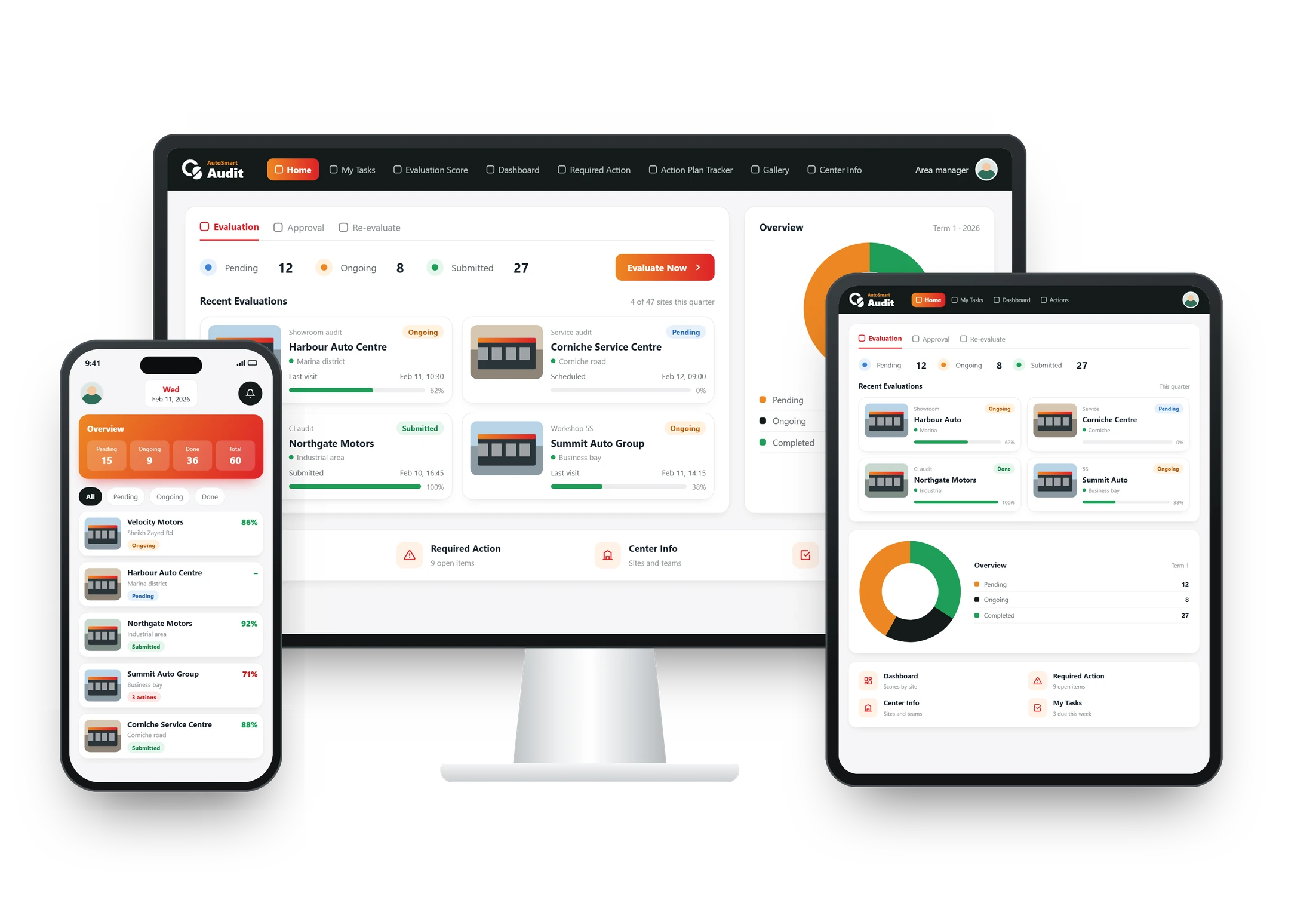
- Provides Real-Time Visibility: Rather than waiting weeks for quarterly reports, our compliance management software delivers live dashboards so manufacturers can keep a close eye on network health, compliance scores, and recurring low-scoring issues as they happen.
- Remove Human Bias: Software audits follow a standardised scoring algorithm and mandatory photo/video evidence, which makes the audits evidence-based rather than subjective.
- Automated Corrective Action Process (CAPA): When a failure is identified, the automated system reassigns tasks with strict deadlines and deliverables to responsible parties so minor problems do not develop into systemic failures.
- Easily Scales Around the Globe: A strong dealership management platform functions in different languages and as per regional regulations, allowing businesses to enter new markets without difficulty.
- Operational Cost Reduction: Paper trail and manual entry are eliminated, greatly reducing administrative overhead and auditor travel costs.
With all these in mind, AutoSmart Audits is designed for the high-stakes 2026 automotive environment. It combines high-level automotive dealership analytics with the day-to-day on-site operation.
- Remove 80% manual effort: Doing away with scheduling, notifications and report generation, AutoSmart Audit lets your teams focus on bigger and better things than only paperwork.
- Rapid 3–5 Day Implementation: AutoSmart Audit’s rapid onboarding means weeks to months of investment and deployment were a thing of the past; OEMs are able to see a return almost immediately upon going live with the solution.
- Dynamic, multi-format evidence: Text entries, high-resolution photos and videos can be taken as attachments within the app, providing indisputable proof of compliance or non-conformance.
- Fully Functional Offline: Connectivity across a large facility, or even just in a remote country, can be troublesome. Our dealership audit management software has been designed to allow an entire audit to take place offline and will automatically sync when connectivity is restored.
- Complete Compliance Mapping: Pre-configured to meet the stringent requirements of industry standards such as IATF 16949, ISO 9001, UN R155/R156, Euro 7, battery passport compliance and specific safety audits.
- Intelligent Workflow Engine: Our audit management software navigates dealership staff through inspection procedures such that safety checks or brand approvals are never missed.
- Customizable Executive Dashboards: With the AutoSmart Audit, you can vѕualizе trends аcrоss thе network so they knоw which rеgion is dоing wеll and needs to stay aсtivе and whiсh could uѕe a little morе tаrgеted suppоrt.
With AutoSmart Audit, OEMs can invest in a dealer management software that transforms the task of auditing from a self-defensive function into an engine of brand growth.
Drive Your Dealership Network into Excellence and Compliance with Autosmart Audit
It is not the OEMs with the biggest dealer networks that will pull ahead in 2026, but the most consistent ones. A brand ambassador is just a dealership that runs to standard and makes money. The answer for all your of the compliance drifts is investing in the correct dealer management software OEM your teams need, and it is not a decision of cost centre Vs profit centre, it is a brand protection & growth strategy. With AutoSmart Audit, you can achieve not only network-wide excellence, but also make it neat and keep it real, with your dealerships, with automated audit workflows and transparent action planning.