
Running a single dealership facility audit is straightforward. Running 80 of them, across multiple markets, with different field representatives every quarter, is where dealer facility audit standardisation becomes not just useful, but operationally necessary.
For OEMs and distributors, the facility audit programme is only as strong as its least consistent field visit.
When two auditors evaluate the same service bay using different views of the same standard, the data can’t be compared. This means you can’t benchmark it, compare it across locations, or use it for network-level decisions. The audit happened. The paperwork exists. The programme has produced noise instead of intelligence.
This is the core challenge that dealer development teams, field operations managers, and aftersales network heads face when running dealer facility inspection programmes at scale, and it is one that most organisations underestimate until the data starts contradicting itself.
Why Dealer Facility Audit Consistency Breaks Down Across a Network
Auditor interpretation gaps are the first and most common failure point. A facility audit standard might say that workshop lighting needs to reach a specific lux level. If the checklist isn’t clear, one auditor might accept conditions, but another could raise concerns. Over time, some dealers find out which field reps are stricter. They then adjust their corrective actions to match. The OEM audit programme starts rewarding proximity to lenient auditors rather than genuine compliance.
Checklist version fragmentation compounds the problem. When audit checklists are managed by email or shared drives, field representatives often use different versions. A criterion added after the last cycle may appear in some audits and not others. When results are aggregated, the comparison is invalid from the start.
Evidence standards deteriorate without enforcement. A facility audit finding without photographic evidence is an assertion, not a record. In manual programmes, photo quality and completeness vary by auditor. When a dealer disputes a finding, the OEM or distributor has no defensible record to stand behind.
Follow-up falls off the programme entirely. The audit produces a report. The report is emailed to the dealer and filed by the regional manager. Six weeks later, no one has verified whether the non-conformances were resolved. The same findings appear in the next cycle. The programme is running, but it is not improving anything. This is exactly the problem that structured CAPA management is designed to close.
What a Standardised Dealer Facility Inspection Programme Requires
For an OEM or distributor with a dealer network, standardisation ensures that every facility inspection gives consistent, reliable, and useful data. This holds true no matter who conducts the inspection, where it is done, or which dealer is involved. That requires consistency at four levels.
Checklist standardisation. The facility audit checklist must be the same document for every auditor in the network, with no room for local version drift. Every criterion must be written in unambiguous language with defined pass conditions. When subjective assessment is necessary, the checklist should have reference standards. For example, include a photo of compliant signage and one showing non-conformance. Updates must be applied centrally and take effect simultaneously across the entire field team.
Scoring standardisation. The scoring model, zone weights, point values per criterion, and non-conformance tier classification, must be part of the audit system. It shouldn’t be up to individual field representatives to calculate it. A major non-conformance in the workshop results in a specific point deduction. This deduction must be the same, whether the audit occurs in Dubai or Riyadh, and regardless of whether a senior field manager or a new evaluator conducts it.
Evidence standardisation. Every non-conformance finding must include a photo. This photo should show the specific checklist item it supports and be taken during the audit, with a timestamp. Without this, the OEM can’t verify findings, defend decisions in franchise reviews, or track whether facility conditions are improving or worsening over audit cycles.
Action closure standardisation. The audit finding should lead to a corrective action. This needs a named owner at the dealership, a clear deadline, and a closure condition. The closure can be either a follow-up visit or photos showing the resolution, submitted through the same system. Without this loop, the audit programme is a measurement exercise with no connection to improvement.
What Consistent Facility Audit Data Enables Across a Dealer Network
When dealer facility audits are consistent throughout the network, the results turn into strategic data. This helps with network quality management instead of just being individual snapshots.
Cross-network benchmarking becomes meaningful. An OEM or distributor can check workshop compliance rates in different markets. They can find out which criteria fail most often in the region. Then, they can send field resources to the locations that are at the highest risk.
Recurring finding patterns surface clearly. If many dealers in an area keep failing on the same signage rule, the issue isn’t just with those dealers. It’s probably a standard that needs clearer guidelines, a supplier not meeting specs, or a gap in dealer training. That insight is only visible when the data is consistent enough to be aggregated.
Trend analysis replaces point-in-time reporting. A single facility audit score tells you where a dealer is today. A series of standard scores from different audit cycles shows if they are truly improving, consistently compliant, or gradually declining. Trend data is what OEM and distributor leadership needs to make franchise, investment, and support decisions.
The Additional Challenge for Distributors Managing OEM Networks
For distributors managing a branded network on behalf of an OEM, the standardisation challenge is amplified. The distributor must follow the OEM’s facility standards. They work with a smaller field team that covers a wider area. The data they collect needs to meet both the OEM’s reporting needs and their own network management requirements.
Distributors who run facility audit programmes manually are creating a programme that the OEM will eventually need them to replace.
Every major automotive market is moving towards digital, standardised, evidence-based audit programmes. OEMs make franchise and investment choices based on network data, so that data must be reliable. Distributors who develop this capability early are in a much better position with their OEM partners than those who rush to add it later.
Three Mistakes OEMs Make When Scaling Facility Audit Programmes
Treating checklist design as a one-time exercise. Facility standards change. New model lines bring new display needs. EV infrastructure is now a compliance must. Environmental rules are also updated. The checklist must have a defined review cycle, not remain static for years while the standard moves on without it.
Measuring audit completion rate instead of finding resolution rate. Tracking “95% of scheduled audits completed” as a programme success metric measures the wrong thing. Completion means an auditor visited. The key metric is: what percentage of major non-conformances from the last cycle were resolved and shown before the next cycle started?
Underinvesting in auditor calibration. Even with a digital checklist, auditors need regular calibration sessions. This helps stop interpretation drift over time. Calibration isn’t just a one-time task. It’s an ongoing part of any facility audit programme. This ensures reliable data from a large field team.
Build a Dealer Facility Audit Programme Your Network Can Trust
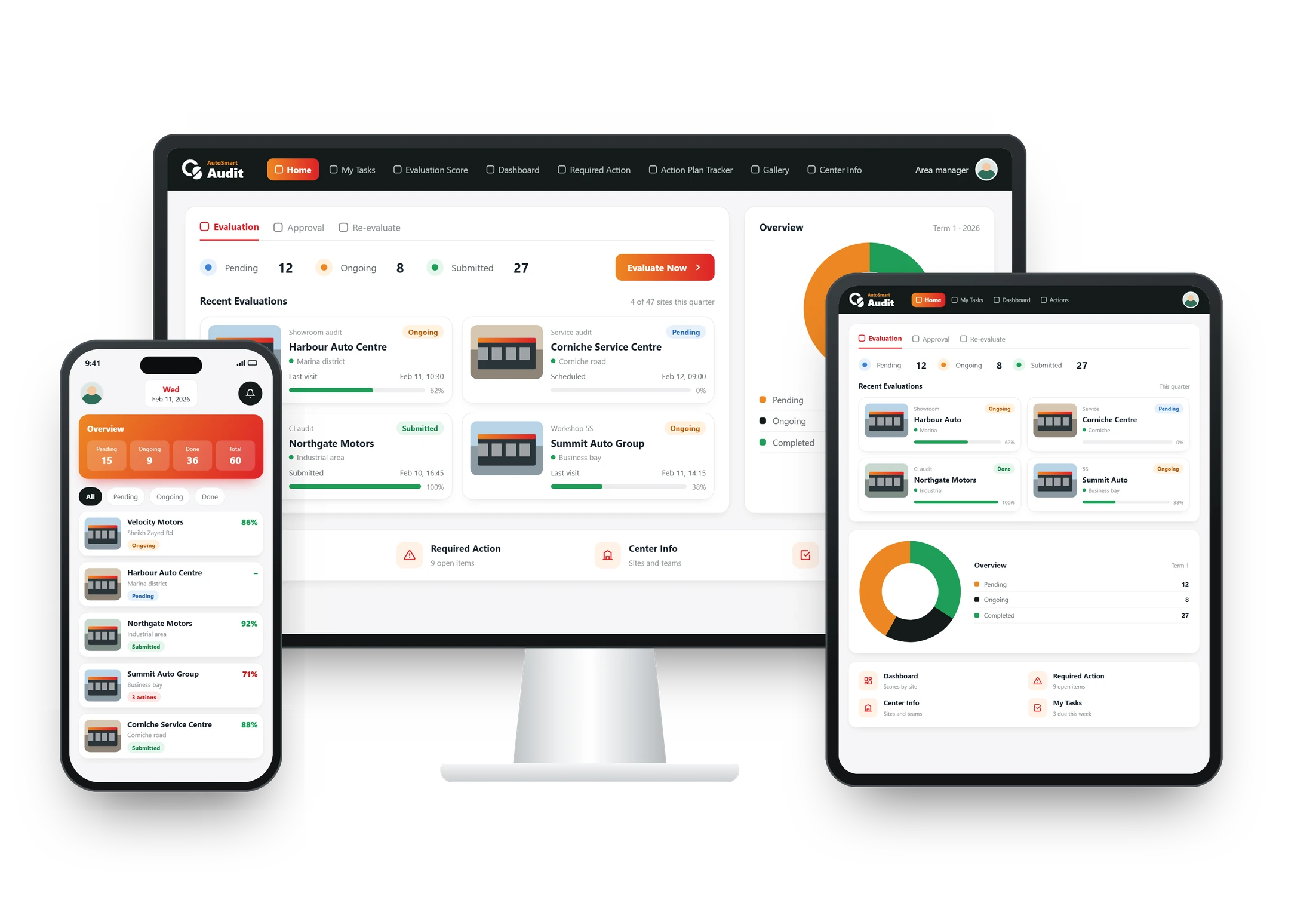
AutoSmart is built for OEMs, distributors, and dealer development teams managing facility inspection programmes across large networks. Standardised digital checklists, automated weighted scoring, mandatory photo evidence, real-time dashboards, and closed-loop CAPA management, all in one platform, purpose-built for automotive.
Schedule a free demo to see how it works for your network.
FAQ: Dealer Facility Audit Standardisation for OEMs and Distributors
How do OEMs ensure auditors apply facility standards consistently across a network?
Consistent application needs standardised digital checklists with clear pass/fail conditions. It requires automated scoring to eliminate manual calculations. Each finding must have mandatory photo evidence. Also, there should be periodic auditor calibration exercises. Platforms that flag outliers in an auditor’s scores help field operations managers spot calibration issues early.
What is the right facility audit cycle frequency for OEM dealer networks?
Most OEM facility programmes have full inspections every six months or annually. Lighter visits from field representatives happen quarterly. High-risk zones, particularly the workshop, may be included in more frequent operational audits. The frequency should reflect how quickly facility conditions can meaningfully deteriorate, not just field team availability.
How should distributors report dealer facility audit results to their OEM?
The format must meet OEM reporting needs. It should include:
- Overall compliance scores by dealer
- Zone-level breakdowns
- Non-conformance counts by tier
- Resolution status for findings from the last cycle
Digital audit platforms that generate standardized reports automatically, and give OEMs shared dashboard access, eliminate the manual compilation step that historically delayed reporting by days or weeks.