
 AutoSmart Guidebooks
What this guidebook covers
A US dealership workshop combines chemicals, heavy lifts, grinding wheels, spray paint, high-voltage equipment and forklifts under one roof. OSHA fines are per hazard, not per inspection, so a single walk-through can produce a list of citations, each up to $16,550, or $165,514 if willful or repeated.
This guidebook covers 14 OSHA standards with 45 checkpoints across service bays, body shops, parts departments and detailing, from hazard communication and flammable liquids to lifts, grinders, respirators, lockout/tagout, injury records and compressed air.
The 14 OSHA standards
Open a standard to see the law behind it, what is checked, what it can cost and the evidence. Ideal fix times are counted from audit submission.
OSHA-01Hazard communication program7 days
- The law
- Occupational Safety and Health Act of 1970 · 29 CFR Part 1910 (General Industry) · OSHA civil penalty amounts for 2025, unchanged for 2026 · 29 CFR 1910.1200 Hazard Communication: written program, labels, Safety Data Sheets (SDS), training
- What we check
- A written hazard communication program covers every chemical in the shop, with an up-to-date Safety Data Sheet for each, labels on every container (including spray bottles), and trained staff.
- What it can cost
- It's the #1 citation at dealerships. Missing program, missing SDS, missing labels and missing training can be four separate citations: up to $66,200 as serious, $662,056 as willful.
- Evidence
- Program copy + SDS index + training
OSHA-02Flammable liquids stored and used safelyImmediate
- The law
- Occupational Safety and Health Act of 1970 · 29 CFR Part 1910 (General Industry) · OSHA civil penalty amounts for 2025, unchanged for 2026 · 29 CFR 1910.106 Flammable liquids · 1910.307 Hazardous (classified) locations
- What we check
- Flammable liquids are kept in approved safety cans and cabinets, only small working quantities are out, and flammable cleaners are never used in pits or near ignition sources.
- What it can cost
- This is the case that killed 3 dealership workers. A willful citation is $165,514, and a willful violation that causes a death is a crime with jail time.
- Evidence
- Photos of cabinet, pits and cleaners in
OSHA-03Vehicle lifts inspected and operated safelyImmediate
- The law
- Occupational Safety and Health Act of 1970 · 29 CFR Part 1910 (General Industry) · OSHA civil penalty amounts for 2025, unchanged for 2026 · OSH Act §5(a)(1) General Duty Clause · industry standard ANSI/ALI ALOIM (annual lift inspection, trained operators)
- What we check
- Every vehicle lift is inspected at least once a year by a qualified inspector, checked daily by users, and only operated by trained technicians who follow the lift points and locks.
- What it can cost
- A lift crushed a worker's hand and the business got $1.26M in proposed penalties. If a lift falls on someone, it's $165,514 per willful citation and possible jail.
- Evidence
- Photos of lift stickers + training list +
OSHA-04Bench grinders guarded24 hours
- The law
- Occupational Safety and Health Act of 1970 · 29 CFR Part 1910 (General Industry) · OSHA civil penalty amounts for 2025, unchanged for 2026 · 29 CFR 1910.215 Abrasive wheel machinery · 1910.212 Machine guarding
- What we check
- Every bench grinder and brake lathe has its guards in place: the tongue guard within 1/4 inch of the wheel and the work rest within 1/8 inch, and the machine is anchored.
- What it can cost
- Every unguarded grinder is its own citation. With three grinders across the site, that's up to $49,650 as serious.
- Evidence
- Photos of each grinder with gap
OSHA-05Respiratory protection in the body shop7 days
- The law
- Occupational Safety and Health Act of 1970 · 29 CFR Part 1910 (General Industry) · OSHA civil penalty amounts for 2025, unchanged for 2026 · 29 CFR 1910.134 Respiratory protection · 1910.94 Ventilation (spray booths)
- What we check
- Painters and anyone exposed to spray mist have a written respirator program, a medical evaluation, an annual fit test and the right respirator, not a dust mask. Applies when: Wherever respirators are required or provided, especially paint and body shops.
- What it can cost
- No program, no medical evaluation and no fit test: three citations per painter. A body shop with 4 painters faces up to $198,600 as serious.
- Evidence
- Program + fit-test records + photos
OSHA-06PPE hazard assessment and eye protection7 days
- The law
- Occupational Safety and Health Act of 1970 · 29 CFR Part 1910 (General Industry) · OSHA civil penalty amounts for 2025, unchanged for 2026 · 29 CFR 1910.132 PPE general requirements · 1910.133 Eye and face protection · 1910.138 Hand protection
- What we check
- A written, certified hazard assessment identifies the protective equipment each job needs, the employer provides it, and technicians actually wear it.
- What it can cost
- No assessment is one citation; every area without the right PPE can be another. Up to $16,550 each.
- Evidence
- Assessment + training log + photos
OSHA-07Eyewash stations and first aid24 hours
- The law
- Occupational Safety and Health Act of 1970 · 29 CFR Part 1910 (General Industry) · OSHA civil penalty amounts for 2025, unchanged for 2026 · 29 CFR 1910.151 Medical services and first aid (quick-drenching facilities where corrosives are handled)
- What we check
- Where batteries, acids or corrosives are handled, an eyewash station is within about 10 seconds' reach, unobstructed and flushed regularly. First aid supplies and trained responders are available.
- What it can cost
- A technician with acid in the eye and no working eyewash is a serious citation, $16,550, plus a workers' compensation claim.
- Evidence
- Photos + flush log + first aid
OSHA-08Exit routes and fire extinguishersImmediate
- The law
- Occupational Safety and Health Act of 1970 · 29 CFR Part 1910 (General Industry) · OSHA civil penalty amounts for 2025, unchanged for 2026 · 29 CFR 1910.36–37 Exit routes · 1910.157 Portable fire extinguishers · 1910.39 Fire prevention plan
- What we check
- Exit routes are clear, marked and lit. Fire extinguishers are mounted, visible, checked monthly, serviced annually, and staff know how to use them.
- What it can cost
- Blocked exits were part of the $1.26M case above. Every blocked exit and every lapsed extinguisher is a separate citation.
- Evidence
- Photos of exits + extinguisher tags +
OSHA-09Electrical safety24 hours
- The law
- Occupational Safety and Health Act of 1970 · 29 CFR Part 1910 (General Industry) · OSHA civil penalty amounts for 2025, unchanged for 2026 · 29 CFR 1910.303 General electrical requirements · 1910.305 Wiring methods
- What we check
- Electrical panels have 36 inches of clear space, covers and labelled breakers. Extension cords aren't used as permanent wiring, and cords and plugs are undamaged.
- What it can cost
- Each blocked panel and each improper cord is a separate citation: up to $16,550 each.
- Evidence
- Photos of panels and cords
OSHA-10Forklift operators trained and certified72 hours
- The law
- Occupational Safety and Health Act of 1970 · 29 CFR Part 1910 (General Industry) · OSHA civil penalty amounts for 2025, unchanged for 2026 · 29 CFR 1910.178 Powered industrial trucks
- What we check
- Everyone who drives a forklift in the parts warehouse or yard has been trained, evaluated and certified (re-evaluated every 3 years), and forklifts are checked before each shift. Applies when: Wherever forklifts or other powered industrial trucks are used.
- What it can cost
- Each untrained operator is a citation. Three untrained drivers: up to $49,650 as serious.
- Evidence
- Certificates + inspection log
OSHA-11Lockout / tagout7 days
- The law
- Occupational Safety and Health Act of 1970 · 29 CFR Part 1910 (General Industry) · OSHA civil penalty amounts for 2025, unchanged for 2026 · 29 CFR 1910.147 Control of hazardous energy (lockout/tagout)
- What we check
- Before servicing equipment such as lifts, compressors, tyre machines or car washes, energy is isolated and locked with a personal lock, following written procedures.
- What it can cost
- Lockout failures were part of the $1.26M case. If an amputation follows, you must report it within 24 hours, and a willful violation can mean jail.
- Evidence
- Program + procedures + lock register
OSHA-12Injury records and reporting7 days
- The law
- Occupational Safety and Health Act of 1970 · 29 CFR Part 1910 (General Industry) · OSHA civil penalty amounts for 2025, unchanged for 2026 · 29 CFR Part 1904 Recording and reporting occupational injuries and illnesses (Forms 300, 300A, 301)
- What we check
- Work injuries are recorded on the OSHA 300 log within 7 days, the annual 300A summary is posted from February to April, and serious incidents are reported to OSHA on time. Applies when: Recordkeeping applies to employers with more than 10 employees; severe-injury reporting applies to all.
- What it can cost
- Each missing entry and each late report can be cited. Not reporting a hospitalisation is up to $16,550, and it triggers the inspection anyway.
- Evidence
- Logs + 300A + submission receipt
OSHA-13Floors and service pits24 hours
- The law
- Occupational Safety and Health Act of 1970 · 29 CFR Part 1910 (General Industry) · OSHA civil penalty amounts for 2025, unchanged for 2026 · 29 CFR 1910.22 Walking-working surfaces · 1910.28 Fall protection (floor holes and pits)
- What we check
- Floors are kept clean and dry of oil. Service pits are covered or guarded when not in use and clearly marked. Applies when: Pit rules apply wherever the site has service pits.
- What it can cost
- Every open pit and every oil-covered walkway is a separate citation: up to $16,550 each.
- Evidence
- Photos of floors and pits
OSHA-14Compressed air used safely24 hours
- The law
- Occupational Safety and Health Act of 1970 · 29 CFR Part 1910 (General Industry) · OSHA civil penalty amounts for 2025, unchanged for 2026 · 29 CFR 1910.242(b) Compressed air used for cleaning
- What we check
- Compressed air for cleaning is reduced to less than 30 psi with effective chip guarding, and it's never used to blow dust off clothes or skin.
- What it can cost
- A simple fix, but each unrestricted nozzle is a citation: up to $16,550.
- Evidence
- Photos of nozzles
How to run an OSHA workshop safety audit, step by step
- Confirm what applies. Walk every area OSHA would: service bays, body shop, parts department and detail. Repeat violations count across all company sites.
- Walk the site, standard by standard. Score each of the 45 checkpoints Pass, Fail or N/A. N/A only where the standard rules it out, with the reason recorded. Check safety data sheets for the chemicals in use, lift inspection dates, grinder guards and forklift operator certificates.
- Capture the evidence. A pass counts only with proof captured at the time of the audit: the written hazard communication program, safety data sheets, lift inspection records, training certificates and the OSHA 300 log.
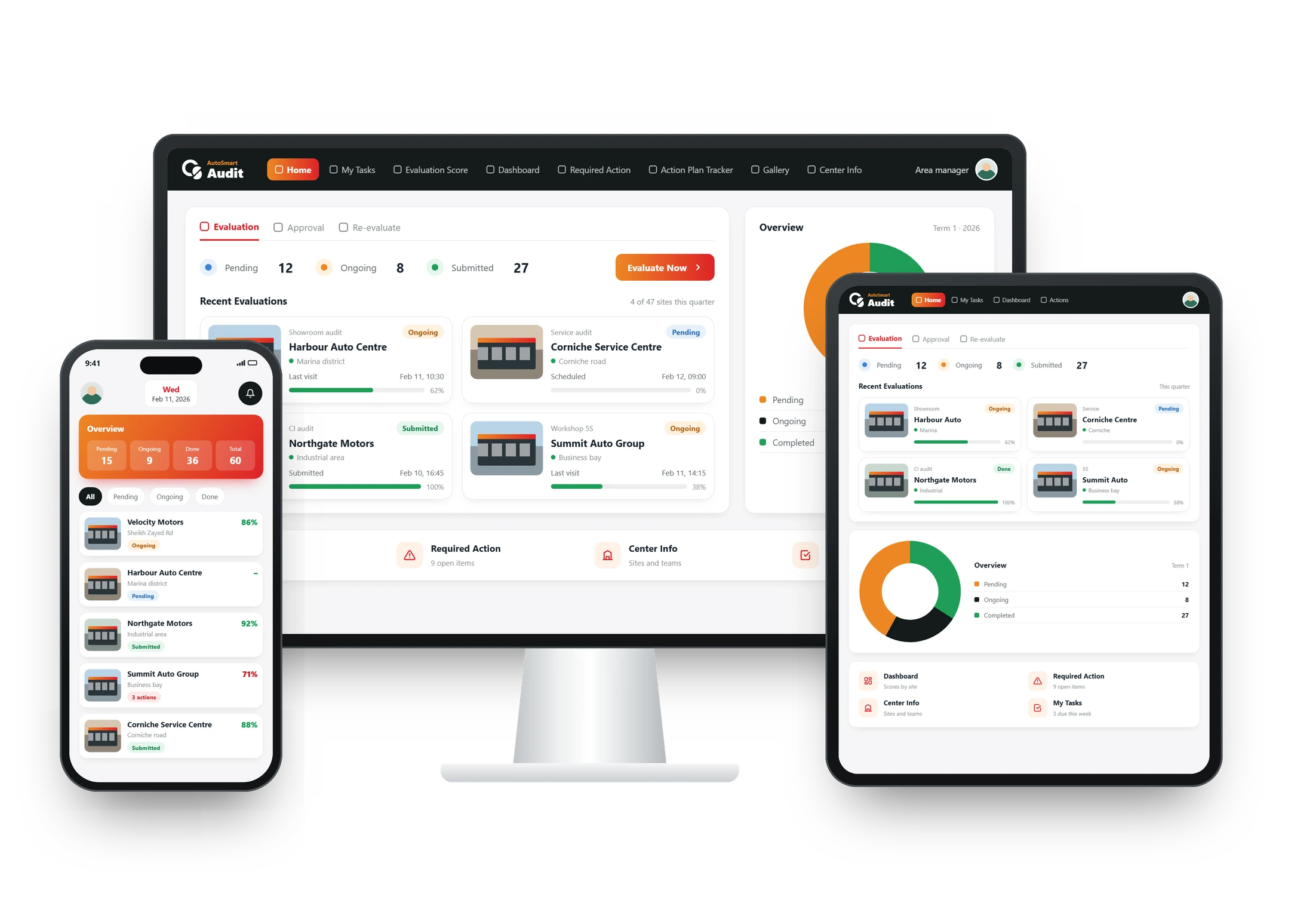
- Give every fail an owner and a fix time. Record what you saw and who owns the fix. Each standard carries an ideal fix time, from immediate to 7 days, counted from audit submission (see the table above).
- Fix it, then prove it. The site fixes the cause and uploads proof of closure; the auditor checks the proof before closing the finding.
- Re-check at the next audit. Confirm closed findings stay closed, and look for the same fail at your other sites so one gap doesn't repeat across the network.
Who this guidebook is for
- Dealer principals
- Service and facility managers
- Safety officers
- Auditors
A reference document, not legal advice. Fines and rules change: check the current text with the regulator or your legal adviser before acting.