

Disclaimer: AutoSmart Audit is not affiliated with or endorsed by Mercedes-Benz. All references are based on publicly available information.
The Mercedes-Benz Dealer Evaluation (MBDE) checks whether authorized dealerships meet global retail standards consistently. It assesses facility presentation, sales process integrity, after-sales service, employee skills and customer experience.
Managing one Mercedes-Benz dealership to luxury standards is demanding. Managing thirty, and knowing which one is slipping before the evaluation arrives, is a different problem. This guide explains what MBDE assesses, how it differs from a standard facility audit, and how dealers and distributors can prepare.
What MBDE Assesses at a Dealership
Publicly available information indicates that dealerships are evaluated across these connected areas.
Corporate identity and facility compliance
Mercedes-Benz uses its MAR2020 retail design standard as the benchmark for showrooms globally. Auditors check signage placement, lighting, display layouts, lounge presentation and external branding. Even small issues like misaligned logos, worn upholstery or dim lighting can lower an MBDE score.
Sales process effectiveness
This area examines how well the sales team follows the customer journey set by Mercedes-Benz. Auditors look for:
- Structured needs assessments
- Correct vehicle presentation
- Test drive protocols
- Proper use of digital tools like the MBUX configurator
The focus is on process adherence, not just conversion rates.
After-sales and service quality
The service department is assessed on workshop efficiency, technical readiness, service-advisor communication, parts availability and workshop safety. Warranty-process compliance and vehicle handover quality are closely scrutinised, because this area affects repeat customers and long-term retention.
Customer experience and feedback
Mercedes-Benz tracks customer feedback through its Voice of the Customer (VoC) programme. MBDE auditors check how dealerships respond to this data: whether negative feedback leads to corrective action, and whether teams are trained to improve each touchpoint, from the first greeting to post-service follow-up.
Employee training and competency
Customer-facing staff must complete Mercedes-Benz product training, brand-immersion modules and role-specific certifications. Auditors verify training records and may run scenario-based checks on applied knowledge. Gaps often come from poor documentation rather than a lack of training.
A dealership cannot compensate for a weak service department with a strong showroom, because the programme assesses whether the whole retail experience meets the standard.
Why Mercedes-Benz Standards Are Assessed Differently
The standards applied to a Mercedes-Benz dealership are stricter than those applied to a volume brand. Luxury dealership audit standards reflect what a premium customer expects.
A flickering sign, clutter in the customer lounge, or a salesperson slightly off on grooming would be minor findings in most networks. In a luxury network they are treated as significant findings, because the customer paying a premium is buying the experience as much as the vehicle.
For distributors, that raises the difficulty considerably. Standards resting on daily upkeep cannot be prepared for in the week before an evaluation.
How MBDE Differs from a Standard Facility Audit
A standard OEM facility audit checks whether a dealership meets defined physical and process requirements at a point in time. Mercedes-Benz facility compliance is assessed the same way, but MBDE extends further.
MBDE evaluates the outcome as well as the input. Customer experience and feedback integration sit alongside facility and corporate identity, so a dealership can meet every physical requirement and still score poorly if the experience does not match.
How MBDE Scoring Affects Dealer Standing
MBDE scoring criteria are set by Mercedes-Benz and vary by market. Publicly available information indicates that high scores open the door to recognition, rewards and customer loyalty, while falling short can result in penalties or factory intervention.
For a distributor, the exposure is network-wide rather than location-specific. A single underperforming dealership affects that dealership’s standing. A pattern of similar findings across several locations suggests something the distributor has not addressed: a training gap, an unclear standard, or a facility programme that has not been rolled out consistently.
How to Prepare for an MBDE Evaluation
Preparation should start long before the evaluation. The dealers who score highest treat MBDE as an ongoing standard, not a one-off project.
Run internal pre-audits on a set cycle
Internal audits should mirror the MBDE process quarterly or monthly, to find gaps before a Mercedes-Benz assessor does. Walk-throughs should follow the evaluation’s structure: facility, staff readiness, process adherence and customer data review.
Give each area an owner
Each major area needs a named internal owner, so compliance doesn’t rest on one person:
- A facility manager for MAR2020 compliance
- A sales manager for process adherence
- A service manager for workshop and warranty standards
Keep a live training tracker
Training is one of the easiest areas to fail on documentation alone. A central, always-updated tracker showing certification status for every team member removes last-minute scrambling and gives immediate proof of compliance.
Close findings within set timelines
Findings that stay open raise red flags in later evaluations. Assign every finding to someone, with a deadline and a sign-off step.
Review customer feedback every week
Dealers who do well on customer experience review feedback regularly, not just before audits. Making it part of weekly management meetings helps catch patterns early and document what was improved.
Managing MBDE Compliance Across a Network
An MBDE compliance checklist works at a single dealership. Across a network, a distributor needs the position at every location at once. Three things make that possible:
- Break standards into routines, not events. Facility and presentation items should be checked daily and weekly, not in the week before an evaluation.
- Record findings against fixed criteria everywhere. Consistent criteria are what make results comparable across locations.
- Give every finding an owner and a deadline. Without this, the same item appears at the next evaluation.
The last one is where most programmes fail. Evaluations produce findings reliably. What happens between evaluations determines whether the score improves.
Staying Ahead of Customer Satisfaction Scores
A Mercedes dealer CSI audit assesses customer satisfaction, which is the part of MBDE a distributor can influence least directly and needs to monitor most closely.
Satisfaction scores reflect what customers experienced weeks earlier, so by the time a poor score appears, the cause is already historical. Internal checks that assess the same behaviours the CSI measures, carried out between formal evaluations, give a distributor warning while there is still time to correct it.
Meeting Mercedes-Benz Standards with AutoSmart Audit
The MBDE programme treats luxury standards as a continuous expectation rather than a periodic test. That means the work sits between evaluations, not before them.
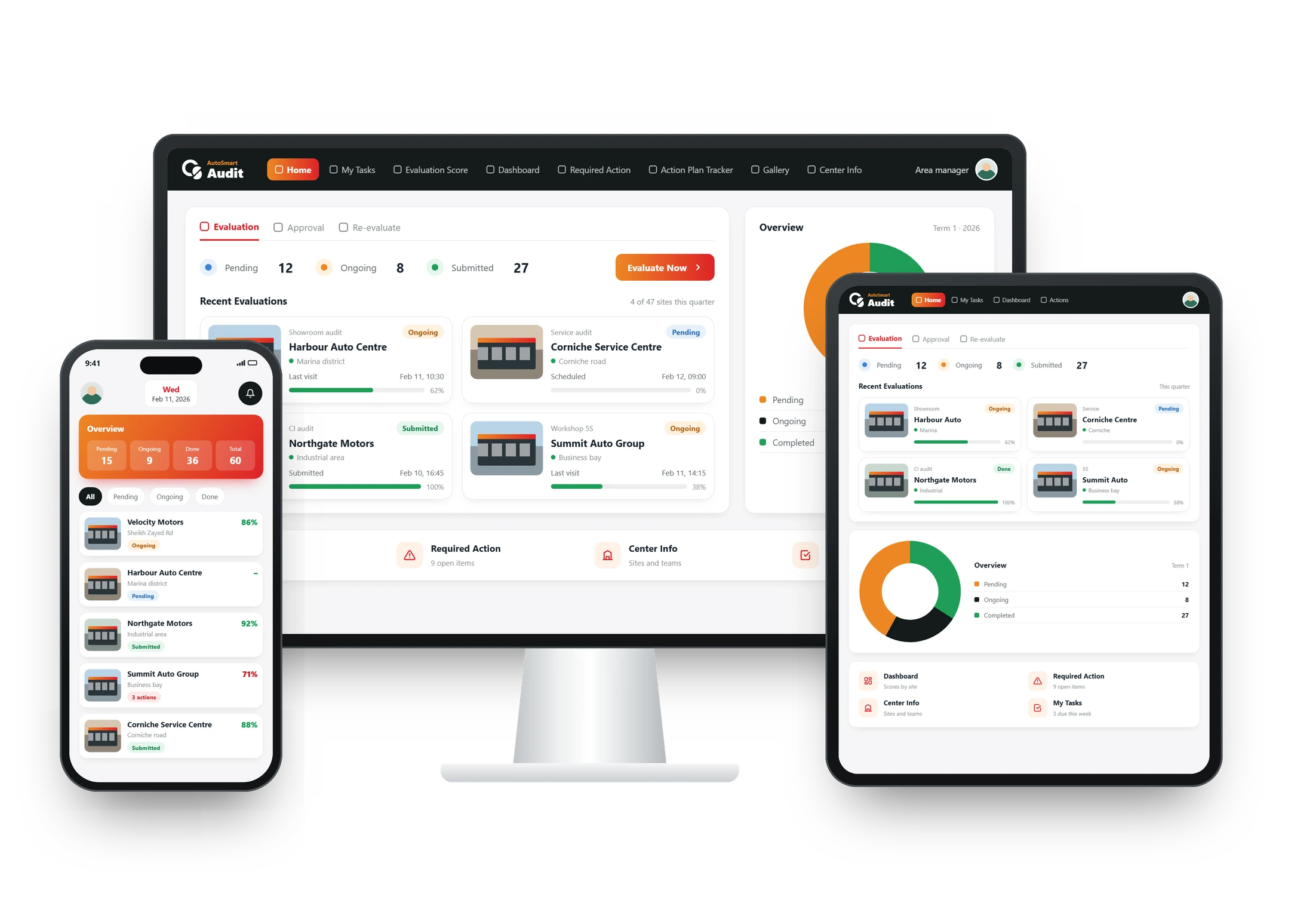
AutoSmart Audit turns these standards into checklists assigned by department, flags issues during guided walk-throughs, and turns findings into tasks with deadlines. Digital reporting shows audit history whenever a representative asks for it, and dealer audits across a network show the position at every dealership before the evaluation arrives.
Book a demo of AutoSmart Audit to see how distributors manage dealer compliance across their networks.