Dealer Operations Heads depend on audit data to maintain network standards, identify risk, and improve dealer performance. Every month, dashboards are reviewed, compliance scores are tracked, and audit reports are circulated across regional teams.
Yet many dealer networks still face the same recurring problem: underperforming dealerships are only identified after issues have already affected customer experience, compliance, or operational consistency.
The issue is rarely the number of audits being conducted. Most automotive networks already run regular audit programs across dealerships, service centres, and regional operations. The real challenge lies in the quality and reliability.
When audit criteria vary between regions, reporting is delayed, or evidence is inconsistent, the data stops reflecting what is actually happening in the network. Decisions become reactive instead of proactive.
For retail operations teams in 2026, the focus is shifting from simply completing audits to building an audit intelligence model that delivers reliable operational insight.
The Problem With Traditional Dealer Audit Reporting
Many dealership networks still rely on disconnected systems and manual processes to manage audits. Checklists are shared through spreadsheets, findings are compiled after site visits, and reports often take days or weeks to reach leadership teams.
This creates several operational blind spots:
- Audit findings are based on subjective scoring
- Evidence is inconsistent across auditors
- Corrective actions are difficult to track
- Regional comparisons become unreliable
- Leadership teams work from outdated information
The result is a network-wide reporting structure that lacks the depth required for accurate operational decisions.
According to AutoSmart Audit, many dealer networks continue to struggle with delayed reporting, inconsistent follow-ups, and limited visibility into audit progress across locations.
When these gaps exist, even high audit frequency cannot produce reliable operational intelligence.
Audit Activity Is Not the Same as Audit Intelligence
Most dealer networks can measure audit activity.
They can report:
- Number of audits completed
- Number of dealers assessed
- Compliance percentages
- Non-compliance counts
- Average network scores
But these metrics alone do not work.
Audit intelligence goes deeper. It helps operations teams identify:
- Which dealerships are showing early signs of operational decline
- Which recurring issues continue across multiple cycles
- Which regions consistently underperform on specific criteria
- Which audit scores may be influenced by auditor inconsistency
- Which corrective actions are failing to resolve root causes
This difference matters because operational improvement depends on trend visibility, not isolated audit snapshots.
A dealership scoring 82% today may appear compliant. But if that same location scored 94%, 90%, and 86% in previous cycles, the trend tells a very different story.
Without longitudinal tracking, retail operations teams lose the ability to intervene early.
Where Dealer Audit Data Typically Breaks Down
Many audit systems fail in predictable ways.
1. Subjective Audit Criteria
If a checklist allows interpretation, scoring differences between auditors become inevitable.
One auditor may classify an issue as minor while another treats it as a major non-compliance. Over time, these inconsistencies distort regional reporting and dealer comparisons.
This is why evidence-backed auditing has become a priority for large automotive networks.
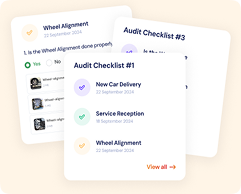
Platforms like AutoSmart Audit support mandatory evidence capture through photographs, annotations, and supporting documents attached directly to checklist responses. This creates traceable audit records linked to every finding.
When evidence becomes part of the scoring process, reporting accuracy improves.
2. Delayed Reporting Cycles
Many operations teams still receive compiled audit reports days after inspections are completed.
By the time leadership reviews the findings:
- Corrective actions have already been delayed
- Dealer conditions may have changed
- Regional managers are reacting to outdated information
Digital audit platforms that capture inspection data directly from the field reduce reporting lag and allow leadership teams to monitor dealer performance while audits are still in progress.
AutoSmart Audit’s real-time dashboard system allows dealer development and field operations teams to monitor branch performance, visit reports, and action plan status from a centralized environment.
This shortens the gap between issue identification and operational response.
3. Disconnected Follow-Up Processes
One of the biggest weaknesses in dealership audits is corrective action management.
In many networks:
- Action points are emailed separately
- Ownership is unclear
- Deadlines are not tracked
- Recurring failures continue across multiple cycles
This creates audit repetition instead of operational improvement.
Modern audit management systems address this by assigning ownership directly within the audit workflow. Each finding is linked to a responsible stakeholder, completion timeline, and status tracker.
According to AutoSmart Audit, action tracking and “Person in Charge” workflows help dealer networks monitor unresolved findings and recurring failures more consistently.
Without accountability tracking, audit programs become documentation exercises rather than operational improvement systems.
4. Lack of Historical Trend Visibility
A single audit score only reflects one moment in time.
Retail operations teams need historical visibility to understand:
- Whether standards are improving
- Which dealers repeatedly fail the same criteria
- Which regions are improving slower than others
- Which operational risks are increasing over time
Longitudinal audit tracking allows dealer networks to move from reactive correction to preventive intervention.
Instead of responding after standards fail, operations leaders can identify downward trends before they become major compliance or customer experience issues.
Questions Retail Operations Teams Should Be Asking
Before introducing new audit processes or technology, operations leaders need to assess the integrity of their current audit data.
Key questions include:
- Can every compliance score be linked to supporting evidence?
- Can you compare dealer performance across multiple audit cycles?
- Can you identify scoring inconsistencies between auditors?
- Are corrective actions tracked to completion?
- How long does it take for audit findings to reach leadership?
- Can regional performance trends be monitored in real time?
If these questions cannot be answered confidently, the network may already be making operational decisions based on incomplete or inconsistent data.
In many cases, the issue comes from outdated workflows, fragmented reporting structures, and disconnected systems.
Building a More Reliable Audit Intelligence Model
Dealer audit programs improve when data quality improves.
That usually requires structural changes in three key areas:
Standardized Digital Checklists
Consistent scoring frameworks reduce interpretation gaps between auditors and regions.
Evidence-Driven Auditing
Photographs, documents, and annotations attached to findings improve traceability and reporting accuracy.
Real-Time Operational Visibility
Centralized dashboards help leadership teams identify operational risk faster and respond before issues escalate.
Solutions like AutoSmart Audit are designed specifically for automotive dealer networks, supporting field audits, compliance management, action tracking, and longitudinal reporting across large operations.
الخاتمة
Running more audits does not automatically produce better operational decisions.
If the underlying data model is inconsistent, delayed, or incomplete, increasing audit activity only increases reporting volume without improving visibility.
Retail operations teams improving dealer standards in 2026 are focusing on audit data integrity first. They are identifying where reporting breaks down, reducing subjectivity, improving evidence collection, and building systems that support continuous operational monitoring.
Assess Your Current Audit Maturity
Retail operations teams looking to evaluate the reliability of their current audit processes can start with the Audit Maturity Assessment by AutoSmart Audit.
The assessment helps organizations review:
- Audit consistency
- Evidence quality
- Reporting speed
- Network coverage
- Longitudinal tracking capability
For dealer networks managing large-scale operations, identifying data gaps early can improve both operational visibility and decision-making quality over time.

Siddharth works in the Founders’ Office at AutoSmart, where he covers strategy, research, and revenue operations. He writes about warranty audits, compliance frameworks, and what the data across audit programmes actually shows.