The challenge
Challenges tyre retail networks face
Tyre brands, dealer networks and fitting-centre chains describe the same three problems.
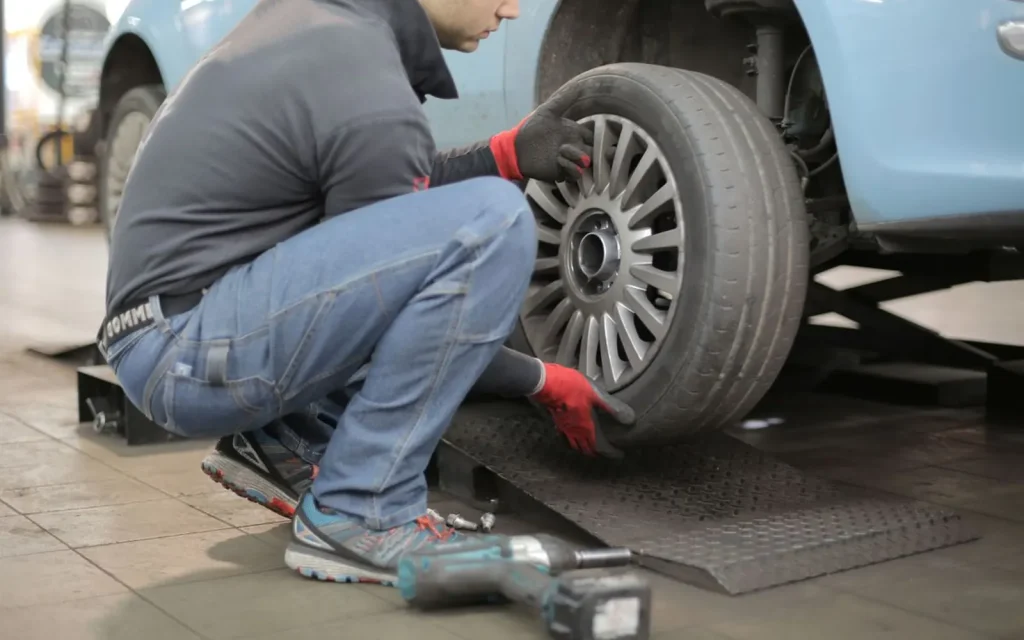
One fitting mistake is a safety incident
Torque not recorded, an inflation cage not used, a wheel not re-checked: small misses in the bay carry the biggest risk.
Old stock ends up on the rack
Without regular checks of the production date, tyres that are too old for sale stay on display and get fitted.
Every centre runs its own way
Stores, bays and customer handover differ from centre to centre, and the brand can’t see where the gaps are.
How AutoSmart helps
How AutoSmart helps tyre retail and fitting centres
Solves challenge 1
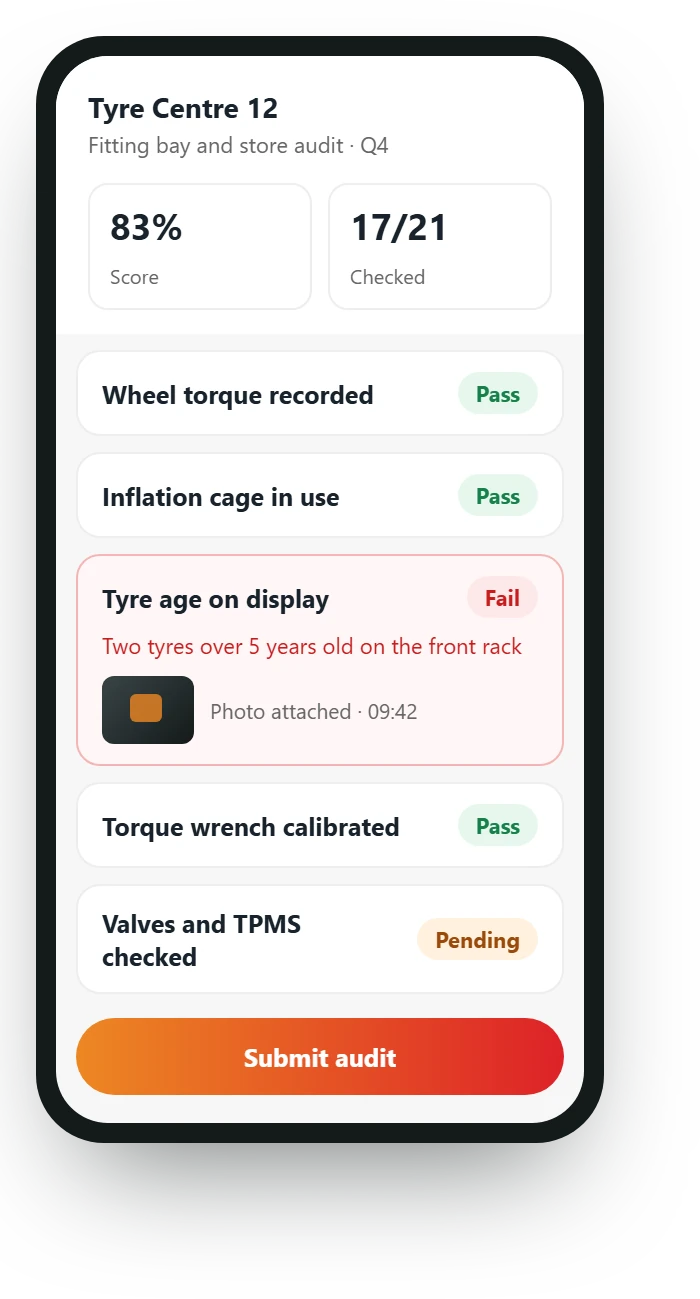
A fitting bay checklist for every centre
Torque, inflation, equipment and store checks become one scored tyre shop audit checklist on the auditor’s phone, with photos where they matter, so every fitting centre is checked the same way.
- Torque and inflation checks recorded
- Photos required where they matter
- Works offline in the bay
Solves challenge 2
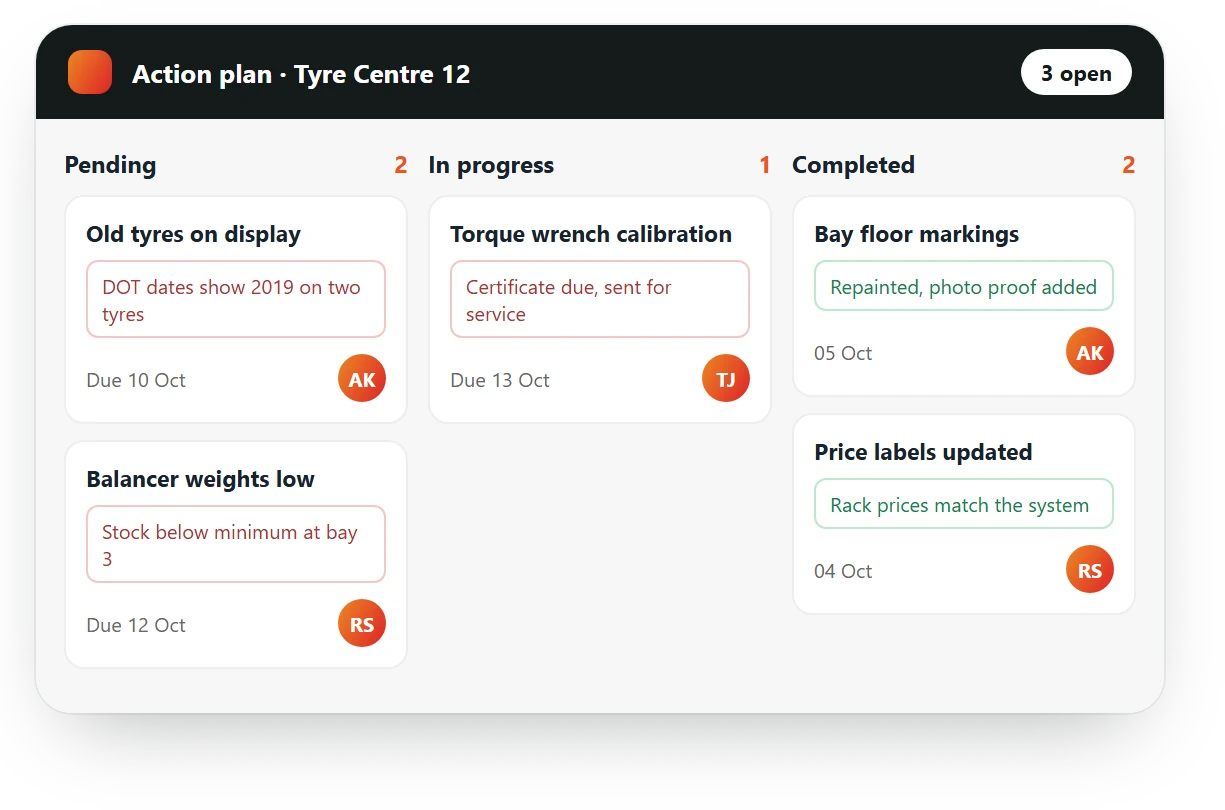
Every finding becomes a fix with a person in charge
Old tyres on the rack or a torque wrench due for calibration become actions with a person in charge and a due date, closed with a photo of the fix.
- A person in charge and a due date
- Pending, In progress, Completed, Approved
- Photo proof of every fix
Solves challenge 3
Every centre compared on one scale
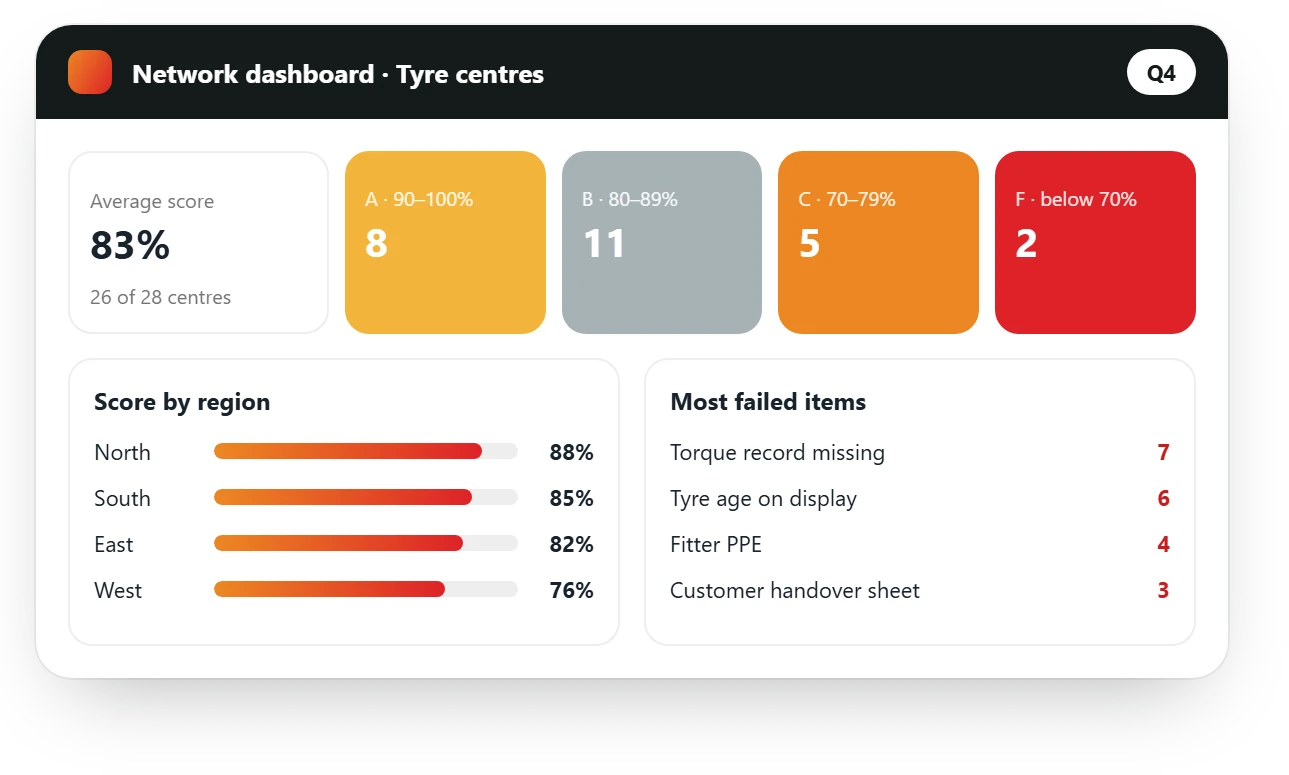
Scores, failed items and open actions reach the dashboard as each audit is submitted, so you see which centres and regions need attention first.
- Scores by region and centre
- Most failed items across the network
- Missed audits flagged
What gets audited
What a tyre shop audit covers
A typical tyre fitting centre audit in AutoSmart is grouped into six areas. Start from it and add your brand’s dealer standard.
Fitting bay safety
- Lifts and jacks inspected
- Inflation cage used for every tyre
- Fitter PPE: gloves, boots, eye protection
- Bay floor clean and marked
Wheels and torque
- Torque setting recorded for each wheel
- Re-torque advice given to the customer
- Wheel balancing checked
- Valves and TPMS sensors checked
Tyre storage and age
- Production date (DOT code) checked on stock
- First in, first out on the racks
- Tyres stored away from heat and sunlight
- Damaged tyres quarantined
Equipment
- Torque wrenches calibrated
- Balancer and changer serviced
- Alignment equipment checked
- Compressor and air lines safe
Store presentation
- Tyre display and price labels
- Brand signage and point of sale
- Customer area clean
- Uniforms and grooming
Customer service
- Tyre inspection explained
- Quote matches the invoice
- Handover sheet with torque values
- Old tyres disposed of properly
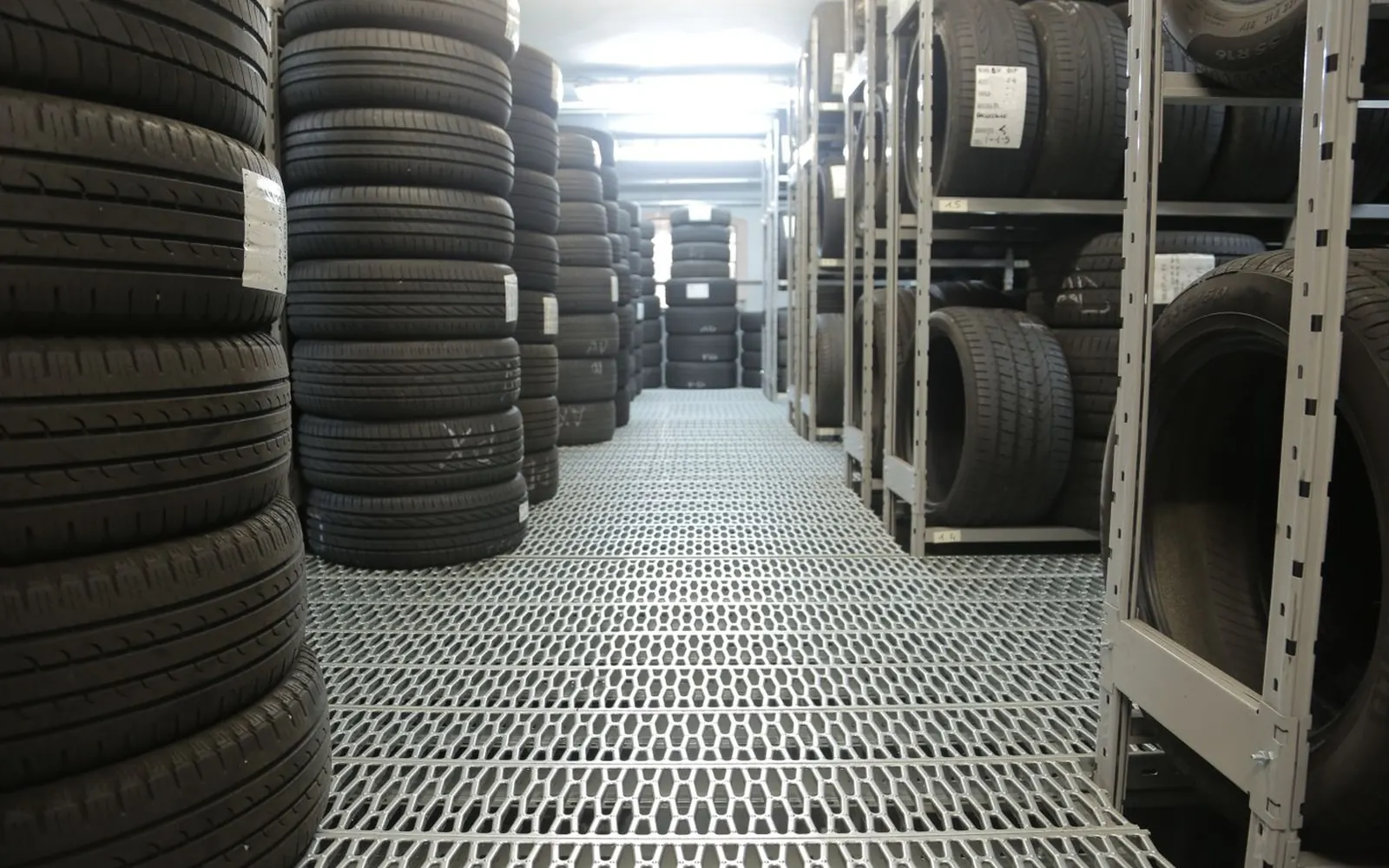
From the stock racks to the fitting bay, every centre checked the same way.
Standards and regulations
Standards and regulations, built into your checklists
Product, safety and brand rules sit in the same audit, so one visit covers all of them.
Tyre production date (DOT code)
The week and year of manufacture, checked on stock and on display.
Mandatory certification marks on tyres sold in India.
GCC tyre conformity (GSO, MOIAT in the UAE)
Conformity and labelling rules for tyres sold in the Gulf.
Workshop safety
Lifts, inflation cages and PPE in the fitting bay.
Your tyre brand’s dealer standard
Your dealer programme: store look, bay set-up and service steps.
Your store standard
Your own checks, scored exactly the way you score them today.
FAQ
Tyre shop audits: common questions
How do you check tyre age during an audit?
The production date is the last four digits of the DOT code on the sidewall: the week, then the year. Auditors check a sample of stock and every tyre on display against your own age limit, and photograph any that fail. A tyre that is too old for sale becomes an action with a person in charge and a due date, closed with a photo once it is off the rack.
How are wheel torque checks recorded in a tyre fitting centre audit?
Torque settings for each wheel, the handover sheet with torque values, re-torque advice to the customer and torque wrench calibration are all questions in the checklist. You can require a photo of the torque record on chosen questions, and attach the calibration certificate as a PDF. A wrench due for calibration becomes an action with a due date, so you can show the check was done.
Can fitting bay safety checks require photo evidence?
Yes, you choose which questions need a mandatory photo, and you can require one even when the answer is compliant. Fitting bay items such as lifts and jacks, inflation cage use, fitter PPE and a marked bay floor can each carry that rule. Gallery uploads can be blocked so photos are taken with the device camera, and each photo can carry its location.
Can tyre brands audit their dealer network?
Yes, company stores and independent dealers sit in one network, grouped by region, and are audited against your tyre dealer network standard. Each dealer sees only their own centres and works through their own actions, while the brand sees every centre on one scale. Grade bands such as Gold, Silver and Bronze show at a glance which dealers meet the standard.
Does the tire shop audit software work offline in the bay?
Yes, auditors can work without an internet connection in the fitting bay or the stockroom. Answers and photos save on the device and upload automatically when the signal returns, and an audit in progress is saved as it goes, so it can be paused and resumed. A dropped signal halfway through an audit does not lose the evidence already captured.
Can we track repeat problems at a tyre fitting centre?
Yes, AutoSmart keeps a full issue history for every centre, so recurring problems such as missing torque records stand out. Each issue can be tagged with a code or category, which makes filtered reports and trends quick to produce. You can compare results month on month or quarter on quarter to see whether a centre has really fixed a problem.
How is AutoSmart priced for a network of tyre centres?
Pricing is per outlet, not per user, so you can add unlimited auditors, centre managers and persons in charge (PICs) at no extra cost. Every customer gets unlimited checklists, the mobile application, photo evidence, automatic action plans and guided set-up. Your own centre standard, with its sections, weights and grade bands, can be built as a custom checklist.
How quickly can a tyre fitting centre audit go live?
A standard set-up can be configured and launched in 3 to 5 business days; larger roll-outs with training and custom workflows take 2 to 4 weeks. Our team helps turn your current checklists into templates, imports your data and trains your users. You can also request a trial instance with sample data to explore the dashboards and reports before you start.