

Most dealership teams know the name of their OEM’s audit program but it’s hard to find a clear explanation of how these programs work. What is the structural logic behind them? What often causes dealerships to fail? Also, how can compliance become a managed operational discipline instead of a seasonal scramble?
This article goes deeper than a list of program names. It explains how OEM dealer standards are set. It also covers what auditors look for and what makes compliant dealerships different from those that often fail audits.
What OEM Dealer Standards Are Actually Trying to Achieve
OEM dealer standards are important. A vehicle manufacturer’s brand reputation isn’t just made in the factory. It grows and strengthens with every customer interaction in the dealer network. The purpose of these standards is not primarily punitive. It is to give every dealership in a network a common framework for delivering a consistent brand experience.
- Facility and Brand Identity: Physical presentation, signage, cleanliness, layout, CI compliance.
- Operational Processes: Workshop efficiency, job card management, parts handling, sales SOPs.
- Customer Experience: Greeting protocols, transparency, complaint handling, follow-up.
- Digital and Reporting: CRM usage, DMS accuracy, warranty documentation, feedback tracking.
The program names vary:
- Toyota has Kodawari and Toyota TSM
- Hyundai uses GDSI and SEA
- BMW conducts CI audits,Benz has MBDE
- Honda has the Clinic.
However, they all share a common focus on these four areas.
How OEM Audit Programs Are Structured
Getting to grips with the structure of these programs helps dealership teams prepare wisely. This way, they won’t see each audit as a separate event.
Standards are tiered, not binary. Most OEM programs use a weighted scoring system across sections, not a simple pass/fail. A dealership can pass an audit overall and still receive a corrective action mandate for a specific underperforming area. This means teams need to track performance section by section, not just overall compliance status.
Audits can be scheduled or unannounced. Most OEM audits are planned ahead of time. However, many programs allow for spot checks. This is especially true if a dealership got a corrective action plan or if regional performance data raises a concern. A dealership that only prepares before a scheduled audit is exposed for the rest of the year.
Corrective action plans are part of the program. When a dealership falls short in a certain area, the audit creates a corrective action plan (CAP). This plan outlines what needs to change, who is in charge, and the timeline for these changes. Follow-up verification is required to close out the CAP. Repeated failures in the same area are taken more seriously than first-time mistakes. This is because they show a bigger problem, not just a one-off error.
Regional OEM teams are actively involved. Standards are set globally, but enforcement is managed at the regional or country level. Regional field reps work directly with dealerships. They share standards, oversee audits, and support improvement plans. That relationship is often as important as the audit score itself in determining how issues are handled.
What Auditors Are Actually Looking For
The difference between what a dealership believes an auditor checks and what the auditor really evaluates often leads to unexpected audit failures.
Documentation is evidence, not a formality. When an auditor asks for job cards or tool calibration logs, they want to see daily records. They also look for PPE records and CRM data. This shows that processes are followed every day, not just on audit day. Incomplete documentation is one of the most frequent reasons dealerships lose points in areas they regard as operationally strong.
Process adherence matters as much as outcomes. Auditors often watch live operations. They see how a service advisor greets a customer. They also observe how a technician documents a diagnosis and how parts are issued. The question is whether actual behaviour matches the SOPs the dealership claims to follow. Great facilities with uneven processes will score lower than average ones with consistent daily routines.
Customer-facing touchpoints receive close scrutiny. The waiting area, service reception, vehicle delivery, and follow-up call are key moments. Customers remember them, and auditors are aware of this. CRM records are frequently reviewed to verify that follow-up calls are genuinely being made, not just reported.
For all 50 standards with the right and wrong way for each, see our free Dealer Standards Guidebook.
Why Dealerships Keep Failing the Same Areas
The main reasons for poor audit performance are structural, not technical. These issues happen often across dealerships and brands.
No internal audit rhythm. Dealerships that only self-assess before an OEM visit have no early warning system. By the time the audit arrives, issues that have been accumulating for months are visible to the auditor, and often to everyone on the floor as well.
Accountability is unclear. When a checklist item fails repeatedly, it is usually because no single person owns it as an ongoing responsibility. Without clear ownership, corrective actions are done once and then fade back to non-compliance within weeks.
Paper-based processes create visibility gaps. When compliance evidence is in binders and printed logs, management can’t see the operation’s status in real time. Issues appear only when someone looks at the records. In a busy dealership, this often happens at the worst times.
Multi-branch inconsistency goes undetected. Dealer groups with multiple locations often notice big differences in audit performance among branches. Regional managers depend on self-reported updates. Without a central view, these reports might not match what an auditor discovers.
Building Compliance Into Daily Operations
Successful dealerships in OEM audits have one key trait: they see compliance as an ongoing system, not just a one-time event.
This means doing regular internal assessments, either weekly or monthly. Use the same criteria that the OEM audits follow. It means giving clear ownership to each part of the checklist. This way, failures lead to quick accountability instead of shared confusion. It means adding evidence capture to daily tasks. This includes completing job cards correctly from the start, updating calibration logs on time, and making CRM entries right at the service point instead of gathering them a week before an audit.
When these habits are in place, the OEM audit validates a system that is already working. When they are absent, the audit reveals a problem that has been invisible to management for months.
How AutoSmart Audit Supports OEM Standard Compliance
AutoSmart Audit is made for automotive dealer networks. It helps manage OEM compliance across one or more locations. Its capabilities directly address the structural problems above.
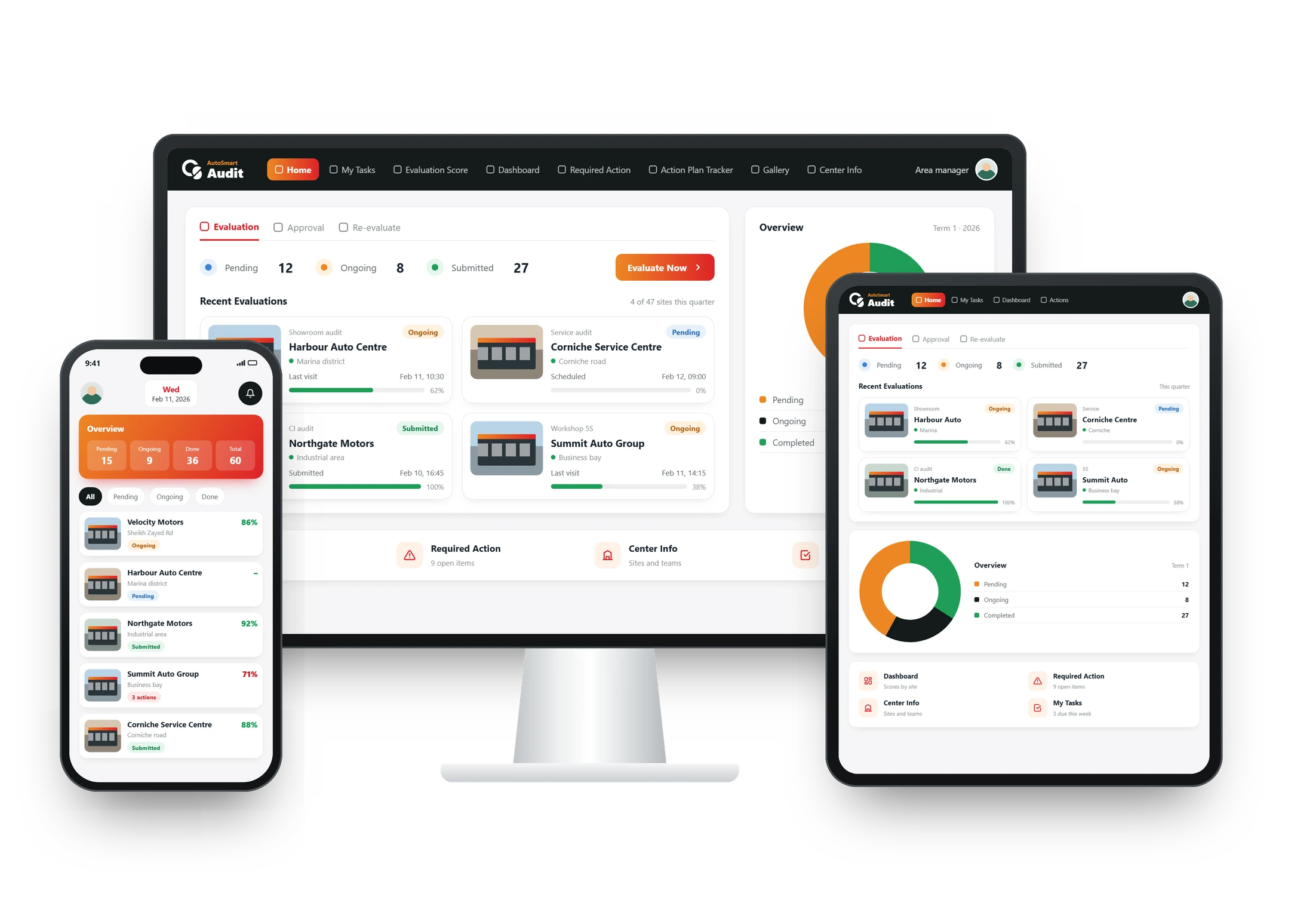
Customisable digital checklists let dealerships match their OEM audit criteria, like Honda Clinic, Kodawari, or SEA. They can conduct internal assessments on any device, even offline in workshops. Evidence is captured and linked at the point of inspection, with photos attached directly to the checklist item they document. Corrective action workflows automatically assign tasks when an item fails. They notify the right person, set deadlines, and flag repeated failures. Real-time dashboards give branch managers and regional teams live updates on compliance for all locations. This is better than a report that comes days later.
Multi-brand dealer groups manage different OEM programs. They can use one platform for all checklists. This also covers compliance data. This reduces the coordination hassle that makes it difficult to manage cross-program compliance manually.
Conclusion
OEM dealer standards are not arbitrary, they are the mechanism through which a manufacturer ensures the brand promise is matched by the customer experience at every dealership in its network. Understanding how these programs are structured, what auditors actually assess, and why failures recur allows dealership teams to approach compliance strategically rather than reactively.
The dealerships that perform best do not manage audits. They manage operations, and audits confirm the result.