
What this checklist covers
A dealership combines very different risks under one roof: customers in the showroom, vehicles moving on site, lifts and chemicals in the workshop, heavy items in the parts store. This template walks the whole site in one pass so nothing is missed between departments.
The Dealership Health and Safety Checklist Template is a 15-point scorecard for dealership Health & Safety standards. Each criterion is scored from 1 to 5 on what the auditor sees on the day, and every gap goes into an action plan with an owner and a close date.
AutoSmart tip: Health & Safety audits should include a physical walkthrough of all work areas: workshop bays, chemical storage, waste areas, and emergency equipment locations. Compliance is only meaningful when it reflects daily conditions, not pre-visit preparation.
The checks
Tap Yes, No or Maybe to try it: your answers stay in this page and clear when you refresh. For a detailed walkthrough, download our PDF or book a demo.
PPE and personal safety
- Are all Personal Protection Equipment (PPE) items available for staff as per the PPE recommendation document, and is proper usage ensured during each repair operation?
- Are PPE items inspected regularly for damage or expiry, with defective items removed from service and replaced promptly?
- Is adequate ventilation provided in areas where fumes, dust, or chemical vapours are generated during repair operations?
First aid and emergency response
- Is a first aid kit available with all essential medicines, with no missing or expired items?
- Is an emergency evacuation drill conducted at least once a year, with records kept (subject to local government regulations), and is the emergency evacuation route displayed in multiple areas of the dealership?
- Is there a documented incident and near-miss reporting procedure in place, and are records of all reported incidents and near-misses maintained?
Fire safety
- Is fire fighting equipment available as per local government regulations, and is there a periodical maintenance record for all fire fighting equipment?
- Is the chemical storage area located away from any source of ignition to ensure safety?
- Are fire exits, emergency lighting, and escape routes clearly marked, unobstructed, and inspected at regular intervals?
Chemical and environmental safety
- Are hazardous chemicals stored properly, labelled correctly, and secured with no risk of leaks or spills?
- Is there an Environmental Policy at the dealer, and is it displayed in the center office or lounge?
- Is there an HFC/CFC recovery and recycling system at the dealer, and is the usage of the system recorded?
- Is there a designated temporary storage area for hazardous waste before it is handed over to a licensed third-party disposal provider?
Facility and equipment safety
- Are vehicle hoists, lifts, and jacking equipment inspected periodically, certified as per manufacturer specifications, and maintained in safe working condition?
- Are electrical panels, switchboards, and wiring inspected periodically with records maintained, and are they free from unauthorized modifications?
How to run it
How the scoring works
Before the visit, fill in the dealer or centre, the auditor, the date and the audit cycle. Then score each of the 15 checks from 1 to 5 on what you see on the day, not on what the dealer or centre aims for, and add them up out of 75.
- 1 Not in place
- 2 Attempted
- 3 Defined
- 4 Managed
- 5 Fully sustained
- Green 60 to 75 · 80 to 100% Compliant. Keep the standard.
- Amber 38 to 59 · 50 to 79% Improvement needed: a structured action plan within 30 days.
- Red 0 to 37 · Below 50% Priority intervention, escalated to regional management.
Then close every gap
Each gap goes into the action plan tracker and moves through four stages until the auditor closes it.
- 1 Pending Person in charge and close date set
- 2 In progress Work under way, evidence gathered
- 3 Completed Evidence submitted for review
- 4 Approved Verified and closed by the auditor
Questions about this checklist
Who should carry out the dealership health and safety walk?
A manager or safety lead who walks the whole dealership in one pass, with department heads joining for their own areas. The checklist covers the showroom, vehicle movements, the workshop’s lifts and chemicals, and the parts store together, so nothing is missed between departments. The walk must be physical: workshop bays, chemical storage, waste areas and emergency equipment locations.
How often should the health and safety checklist be run?
On a fixed audit cycle recorded on the scorecard, and in a way that shows daily conditions rather than preparation for the visit. Some items carry their own timing: an evacuation drill at least once a year, subject to local regulations, and periodic inspection of lifts, electrical panels and fire fighting equipment. Check an area again after any incident or near-miss.
What evidence should we keep from a health and safety audit?
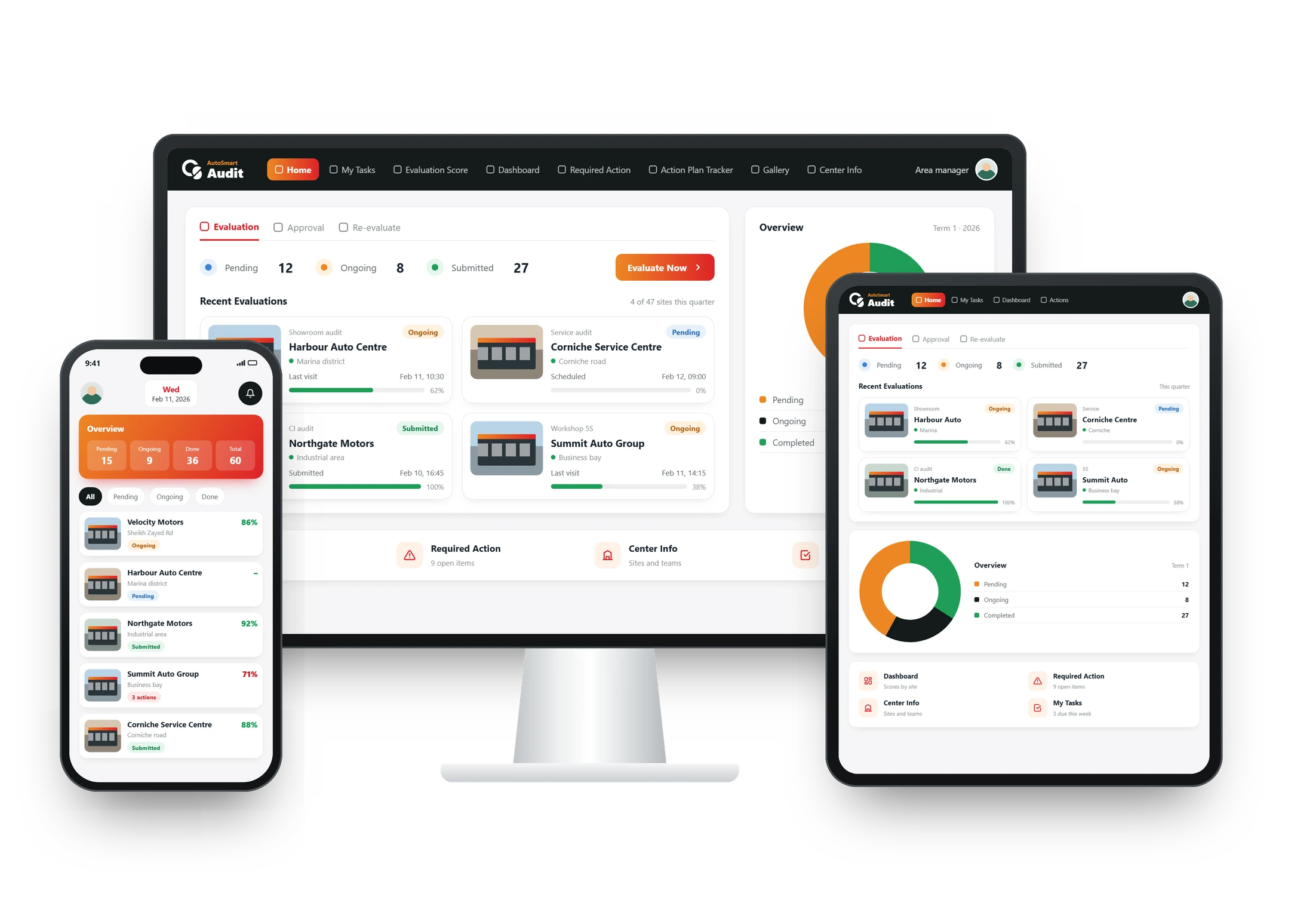
Photos of PPE, first aid kits, fire exits, chemical storage and the hazardous waste area, plus the records the checklist asks for: evacuation drills, incident and near-miss reports, fire equipment maintenance, lift certification, electrical inspections and HFC/CFC recovery use. Evidence of waste handed to a licensed disposal provider helps too. AutoSmart Audit lets you add photos, notes and PDFs to each check, even offline.
How do the Green, Amber and Red bands work for health and safety?
The 15 checks are scored 1 to 5 and totalled out of 75. Green, 60 to 75, means compliant; Amber, 38 to 59, needs a structured action plan within 30 days; Red, 37 or below, is a priority intervention escalated to regional management. For safety, also fix any single serious hazard straight away, such as a blocked fire exit, whatever the total says.
What should happen to a health and safety gap?
Each gap goes into the action plan with a person in charge and a close date, then moves through pending, in progress, completed and approved. Expired first aid items or damaged PPE are quick to close; a missing incident reporting procedure takes longer. The auditor approves the action only after seeing the evidence, such as a replaced item or a new written procedure.