
















The challenge
A dealer audit, the old way
OEMs, distributors and dealer groups check every dealership against their operating and brand standards. On paper, one audit goes like this.
Day 1
The visit
The auditor walks the dealership with paper forms, one for every standard.
Days 2 to 6
Typing it all up
Every answer is typed into a spreadsheet, and the photos are matched by hand.
Day 7
The report
A report is emailed to head office, a week after the visit.
Next visit
The same gaps
Nobody at the dealer owned the fixes, so the same problems are found again.
Auditors write everything on paper, then type it all up later. At MG Motors MEA, checking one dealership used to take 5 to 7 days and about 56 hours of work. Now it takes one day.
How it works
Before, during and after the visit
One platform for the whole dealer audit: the checklist on the auditor’s phone, the action plan the dealer works through, and the dashboard head office reads.
Before the visit
Your standard, ready on the phone
Your operating and brand standards become scored checklists, one place for every standard.
Head office sets the sections, scoring and photo rules once, so every auditor works from the same version and dealers can be compared fairly. Audits are scheduled per dealer, with reminders, so no visit is missed.
No paper, no copying forms, nothing to print before the visit.
During the visit
Score each item, add photos
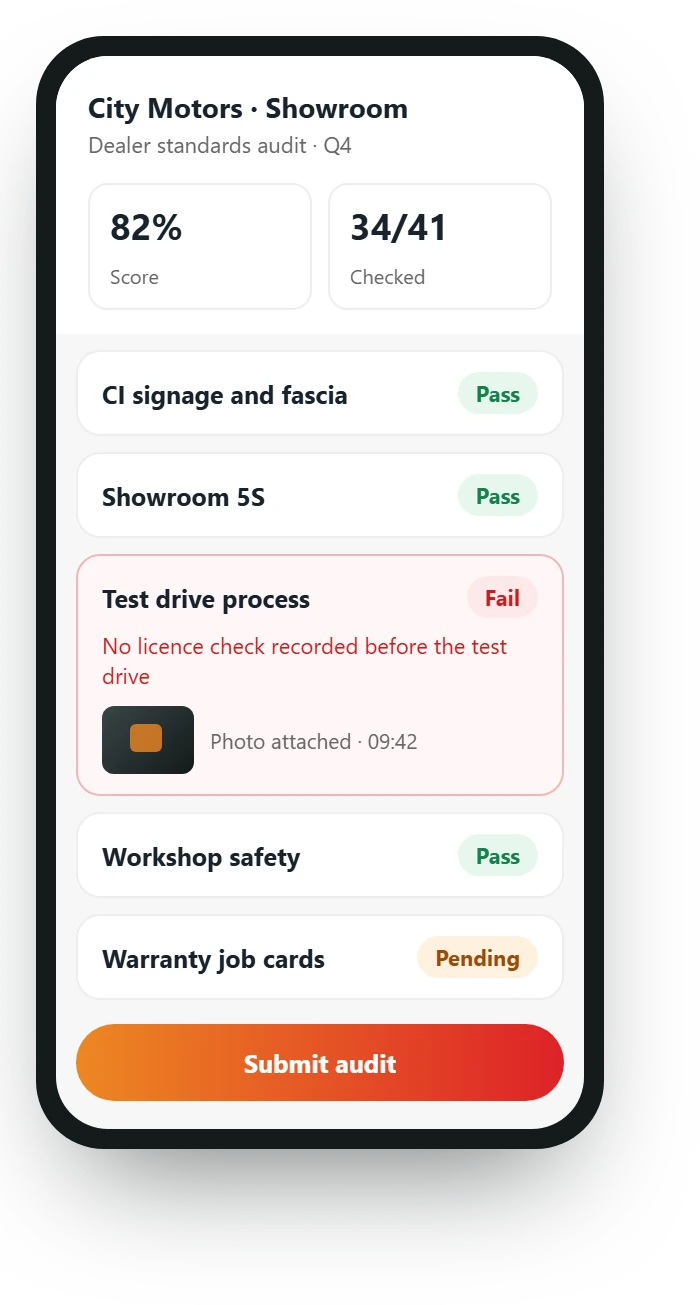
The auditor walks the showroom, workshop and back office, answers each item and adds photos as evidence. The score adds up as they go.
After the visit
Actions for the dealer, scores for head office
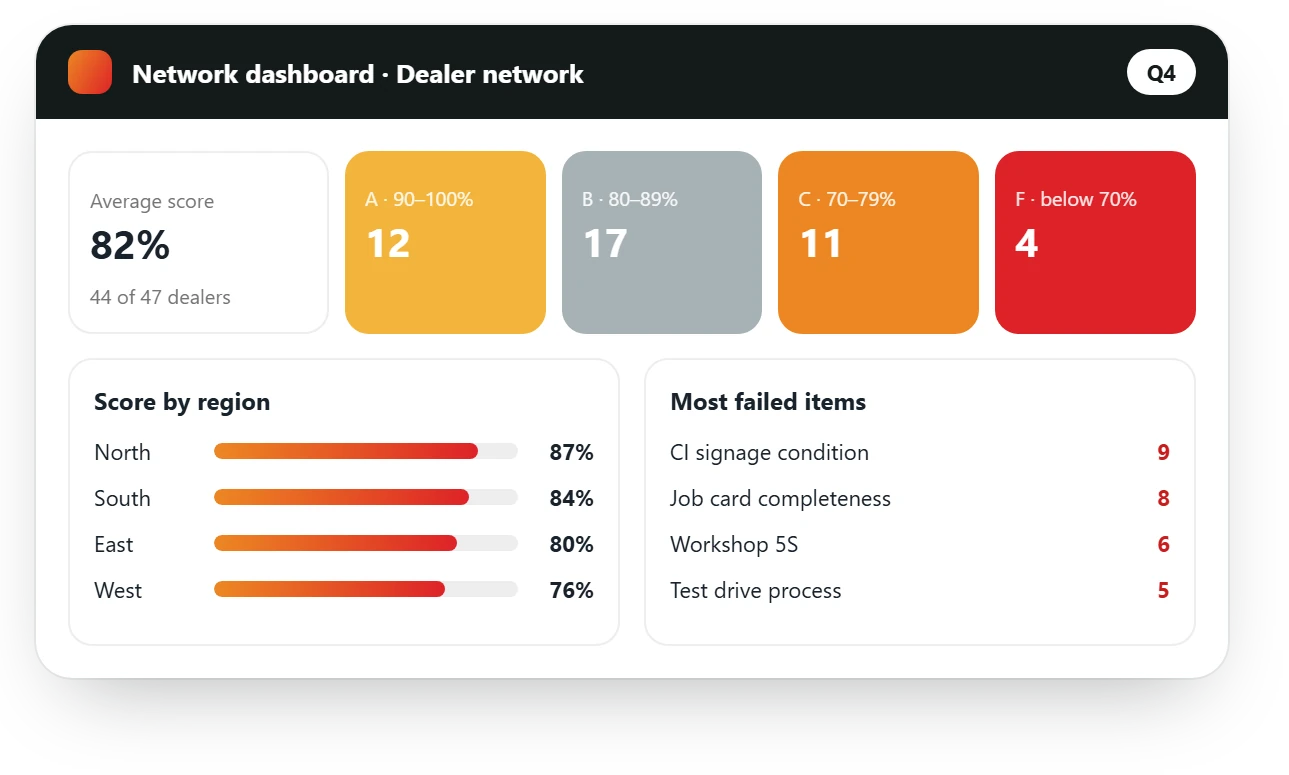
Every gap becomes an action with a person in charge at the dealership and a due date. Head office sees the score the moment the audit is submitted.
Results
Results from dealer networks
Before and after
One dealer, two ways
What gets audited
What a dealer audit covers
Networks usually audit six areas of each dealership. Each can be its own checklist or part of one visit.
Dealer Operating Standards
- Facility and showroom standards
- Staffing and training records
- Processes and KPIs
Brand standards and CI
- Fascia, pylon and signage
- Showroom and lounge design
- Branded materials and uniforms
Sales process
- Greeting and needs analysis
- Test drives and licence checks
- Delivery and handover
Aftersales
- Service reception and job cards
- Parts storage and genuine parts
- Workshop 5S
Customer experience
- Customer lounge standards
- Complaint handling
- Follow-up calls
Sub-dealers
- Same standard as your own dealerships
- Self-audits between visits
- One scale across the network
Who it’s for
Built for the teams that run dealer audits
Network development
Set the standard once and see how every dealer performs against it, region by region, quarter by quarter.
Field operations
Area managers audit on a phone during the visit, leave with the report done and follow each dealer’s actions to closure.
Audit agencies
Agencies auditing for an OEM run the client’s checklist in AutoSmart and hand over scored, photo-backed results.
FAQ
Dealer standards audits: common questions
What is a dealer standards audit?
A dealer standards audit checks each dealership against the network’s operating and brand standards. In AutoSmart, auditors score each dealer on a phone, attach photos, and every failed item becomes a corrective action the dealer owns. Head office sees results for the whole network as each audit is submitted.
Can we use our own OEM or network standard?
Yes. Your standard’s sections, criteria and scoring become a checklist in AutoSmart, so auditors and dealers work from the same standard and results are comparable across the network.
Does it work in workshops with no signal?
Yes. Audits can be completed offline and upload automatically once the device is back online.
How do dealers follow up on findings?
Each failed item becomes an action with a person in charge at the dealership and a due date. The dealer updates it from Pending to Completed with photo proof, and the audit team sees progress without chasing.
How long does a rollout take?
It depends on the size of the network and the number of standards. Kia India piloted AutoSmart in late 2025 and reached network-wide use within one month.

 AutoSmart Industry Insights