Most car dealerships in the GCC don’t fail audits because of major issues. They fail because of small gaps in documentation, VAT handling, and compliance processes that go unnoticed.
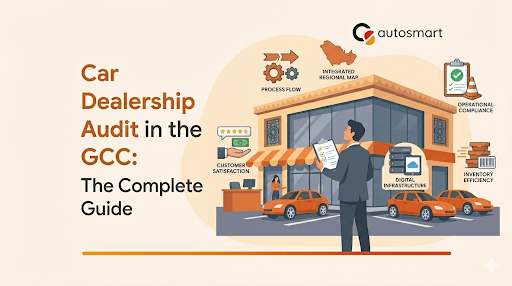
A car dealership audit in the GCC checks a dealership’s finances, inventory, sales methods, and its compliance with rules in the six Gulf states.
They also look at country-specific rules like the UAE’s ESMA and RTA regulations, or Saudi Arabia’s SASO and SABER programme. Additionally, audits cover VAT obligations (5% in the UAE and Saudi Arabia; 10% in Bahrain) and OEM franchise terms.
GCC dealerships must do physical inventory audits at least four times a year. They should also carry out comprehensive compliance audits once a year. Additionally, VAT reconciliation is needed for every tax filing period.
Why Car Dealership Audits Matter in the GCC
The GCC automotive market is both highly competitive and highly regulated. Dealerships in the UAE, Saudi Arabia, Qatar, Kuwait, Oman, and Bahrain have to meet technical standards. They must also follow tax rules. and, they need to comply with consumer protection laws.
Managing audits manually across multiple locations is where most dealerships struggle. Spreadsheets, disconnected systems, and last-minute checks can cause delays, errors, and compliance risks.
Digital audit platforms like AutoSmart help by standardising audits. They track compliance in real time and significantly reduce audit timelines.
The GCC Regulatory Landscape by Country
The GCC Standardization Organization (GSO) establishes a common baseline for vehicle safety and technical standards. However, each country has its own licensing authority, VAT system, and enforcement body. Understanding this landscape is the foundation of any audit.
United Arab Emirates
UAE dealerships must comply with:
- ESMA and GSO vehicle safety standards.
- Roads and Transport Authority (RTA) licensing before vehicles can be sold or driven.
- 5% VAT on vehicle sales, with quarterly filings via the Federal Tax Authority (FTA).
- The UAE Personal Data Protection Law (PDPL, 2022), which applies to customer‑data handling.
- Free‑zone dealers must also hold the relevant Free Zone regulator licence.
Saudi Arabia
Saudi dealerships are subject to:
- SASO (Saudi Standards, Metrology and Quality Organization) technical standards.
- SABER/SALEEM conformity certificates for all vehicles and spare parts before customs clearance.
- A 5% customs duty on vehicle value plus 15% VAT at import, with passenger vehicles limited to a maximum of 5 model years for import and resale.
- 5% VAT on new and used vehicle sales, with 0% VAT on electric vehicles under Saudi green‑mobility‑support schemes.
- SASO 2847 fuel‑economy‑labelling requirements for light‑duty vehicles, applying from model year 2027 onward.
Qatar
Qatari dealerships must:
- Follow GSO technical regulations for all vehicles sold.
- Comply with Ministry of Municipality and Environment (MME) dealer‑licensing rules.
- Track VAT‑related updates via the General Authority of Zakat and Tax (GAZT), as Qatar’s VAT framework is still being implemented.
- Cater to strong demand for premium and SUV‑focused inventory.
Kuwait
In Kuwait, dealerships must:
- Meet GSO vehicle standards and national import rules.
- Comply with Kuwait’s Data Classification Framework (2025), which governs how CRM and customer‑data is classified and stored.
- Keep accurate financial records now, even if VAT isn’t in force yet. This prepares you for its future implementation.
Bahrain
Bahrain’s dealerships operate under:
- 10% VAT applies to vehicle sales, the highest rate in the GCC. VAT needs to be calculated accurately at each deal, reported, and audited by the National Bureau for Revenue (NBR).
- Open Banking Framework (OBF) rules for dealership‑finance and customer‑finance activities.
- Ministry of Interior (MOIC) and other authorities for general business‑licence and automotive‑retail‑licence compliance.
Oman
Oman’s dealerships must:
- Follow GSO vehicle standards and licensing rules from the Public Authority for Consumer Protection and Competition (OTA).
- Apply 5% VAT on vehicle sales, as introduced in 2021, and file accurate VAT returns with the Oman Tax Authority.
- Adapt to growing demand for premium and off‑road vehicles in the Sultanate.
Car Dealership Audit Requirements in the GCC
Regardless of the specific GCC country, a compliance audit will typically examine the same core pillars.
Starting in 2025, all new motor vehicles sold in GCC member states must meet the GSO Technical Regulations for Motor Vehicles. This is known as GSO Technical Regulations MV 2025.
These standards merge EU and U.S. safety rules and adjust them for Gulf conditions, like higher temperatures. Audits ensure that every vehicle on the lot has the right GSO conformity documents. They also check that no non-GSO-compliant vehicles are for sale.
Want a ready to use GCC dealership audit checklist?
Check out the GCC dealership audit checklist to simplify your audit process.
Vehicle Inventory and Documentation
Each vehicle must have a complete paper trail.
This includes:
- VIN
- Chassis document
- Certificate of origin
- Customs clearance certificate
- GSO, ESMA, or SASO conformity certificates
In Saudi Arabia, the SABER conformity certificate must be present before the vehicle clears customs. During an audit, physical stock counts are compared with your Dealer Management System (DMS). This process identifies discrepancies that could suggest administrative errors, misappropriation, or exposure to floor-plan financing risks.
VAT Records and Filing Accuracy
VAT is one of the most actively audited areas. The UAE and Saudi Arabia apply 5% VAT to vehicle sales, Bahrain applies 10%, and Oman applies 5%. Qatar and Kuwait are at various stages of VAT rollout. Audits test:
- Correct VAT calculation at the deal level.
- Proper VAT invoicing and documentation.
- Accurate VAT reporting to the FTA, ZATCA, NBR, or OTA, as applicable.
- Correct zero‑rating treatment of electric vehicles in Saudi Arabia.
Import and Customs Documentation
Since nearly all GCC vehicles come from abroad, customs documents are key to the audit.
Authorities like the FTA, ZATCA, and NBR check commercial invoices, bills of lading, certificates of origin, and conformity certificates. They do this to make sure these documents match inventory records and VAT filings.
Licensing and Corporate Records Dealers need valid operating licences from the right authority. This could be the Department of Economic Development in the UAE or the Ministry of Commerce in Saudi Arabia. In the UAE, Free‑Zone dealers must additionally hold the correct Free Zone licence. The UAE’s Commercial Companies Law (Federal Decree‑Law No. Saudi Arabia’s corporate governance rules require current corporate documents and shareholder agreement records.
Customer Data and Privacy Compliance
The UAE Personal Data Protection Law (PDPL, 2022) and Saudi Arabia’s Personal Data Protection Law (2021) require dealers to:
- Get clear consent for data collection.
- Limit access to authorised staff.
- Safeguard customer information in CRM and finance systems.
Similar data‑classification and protection expectations are emerging in Kuwait and other GCC states.
Automotive Dealership Audit Procedures: Step‑by‑Step
1. Identify the Relevant Regulations Before any on-site review, clarify which standards and authorities apply to your market.
A UAE dealership must focus on ESMA, RTA, and FTA rules; a Saudi dealer must focus on SASO, SABER/SALEEM, ZATCA, and Muroor. This mapping defines the audit’s scope.
2. Gather and Organise Documentation
Collect these important documents:
- Conformity certificates
- Customs clearance records
- Vehicle registration documents
- VAT tax invoices
- Completed deal files
- Floor-plan financing statements
- Corporate licences
Make sure each vehicle in stock has valid SABER/SALEEM certificates (for Saudi Arabia) or ESMA/GSO certificates (for UAE and other GSO-aligned markets).
3. Physical Inventory Count and VIN Reconciliation
- Walk through the entire lot.
- Record each VIN, noting its condition and status.
- Keep track of all documentation.
Cross‑check this physical count against the DMS. Pay special attention to:
- Vehicles approaching the 5‑model‑year‑import‑age limit in Saudi Arabia.
- Any vehicles that appear in the DMS but are not on the lot, or vice versa.
- Non‑GSO‑compliant vehicles or test‑drive units that may be improperly recorded.
Many dealerships now use digital audit tools to track VINs, attach images, and reconcile inventory in real time instead of relying on manual logs.
4. VAT and Financial Transaction Testing Select a sample of completed deals and verify:
- VAT was calculated correctly and applied to the correct tax‑invoice lines.
- VAT‑input claims on purchases and repairs match supporting documentation.
- VAT returns match the ledger and DMS records.
- EVs in Saudi Arabia are correctly zero‑rated in both the DMS and the VAT filing.
5. OEM Warranty and Incentive‑Programme Review
OEMs audit dealers for:
- Accurate warranty claims, including proper documentation and service records.
- Correct use of co‑op marketing funds and dealer‑incentive programmes.
- Timely submission of claims within the OEM’s specified window.
6. Data Privacy and Customer‑Records Review Auditors check:
- Whether written internal data‑protection policies exist.
- Whether customer consent is documented for marketing and data‑processing activities.
- Whether access to CRM and finance records is role‑based and auditable.
7. Findings Report and Corrective‑Action Plan
Compile findings into a prioritised report with clear action items. For VAT issues, dealers should disclose before a government audit. Voluntary disclosure often leads to lower penalties. For OEM‑related findings, review the franchise agreement for challenge and appeal timelines.
Streamlining Car Dealership Operations in the GCC
Audit readiness and operational efficiency go hand in hand. Dealerships that weave compliance into daily tasks do better than those that see audits as rare stress events.
- Digital conformity-certificate management: Keep all GSO, ESMA, and SASO certificates online. Get automatic alerts for expiry and renewals.
- Real-time DMS-to-floor-plan check: Make sure your DMS inventory matches lender-financed vehicle records. This helps you avoid “out of trust” issues.
- VAT-compliant deal-file structuring: Standardise deal templates. This way, every sale creates a tax-invoice-ready file that meets FTA, ZATCA, and NBR requirements.
- Segregation of Financial Duties: Separate tasks for inventory postings, journal entries, and payment approvals. This helps reduce fraud and errors.
- Annual Compliance Training: Train sales, service, finance, and admin teams on VAT, GSO/SASO rules, and data protection obligations.
- EV Compliance Readiness: Make sure staff know about EV-specific VAT rules in Saudi Arabia. Also, clarify the technical certification requirements for batteries and charging systems under SASO.
As audit requirements across the GCC become more complex, manual processes are becoming harder to manage.
Digital audit platforms like AutoSmart help dealerships:
- Standardise audits across branches
- Capture real-time evidence with images
- Track compliance gaps instantly
- Reduce audit time significantly
This allows teams to focus less on preparing for audits and more on improving operations.
Preguntas frecuentes
What is a car dealership audit in the GCC?
A car dealership audit in the GCC reviews a dealership’s financial records, inventory, and sales processes. It checks if they follow regional and national rules. This includes GSO vehicle standards, country-specific VAT laws, customs documents, licensing needs, and OEM franchise rules. It may be conducted internally, by an OEM, by a floor‑plan lender, or by a government tax or technical‑standards authority.
What regulations apply to car dealerships in the UAE?
UAE dealerships need to follow several important regulations. These include:
- ESMA and GSO vehicle safety standards
- RTA licensing requirements
- 5% VAT rules from the Federal Tax Authority
- UAE Personal Data Protection Law (2022)
- Commercial Companies Law (Federal Decree‑Law No.20 of 2025).
Dealerships in Free Zones must also hold the relevant Free Zone regulator licence.
How often should GCC car dealerships conduct an audit?
GCC dealerships should do physical inventory audits at least every three months. They need to carry out full financial and compliance audits once a year. Also, VAT reconciliation should happen during each tax filing period. Floor‑plan lenders may require monthly physical stock counts and reconciliation with their financing records.