Most auto repair businesses take pride in diagnosing engines and fixing complex mechanical issues. But while technicians are busy under the hood, what’s happening inside the shop often goes unchecked.
In a competitive and compliance-driven market, a successful workshop is defined by how effectively it runs its operations.
That’s where operational audits come in.
Understanding Operational Audits in Auto Repair
An operational audit in an auto repair shop is a structured, data-driven review of how your business functions, from the front desk to the final invoice. Unlike financial audits that focus solely on numbers, operational audits dive into your shop’s day-to-day workflows and service quality.
An effective workshop operational audit assesses:
- Compliance with service center standards and OEM procedures
- Accuracy and transparency in estimates and billing
- Efficiency in parts procurement and inventory management
- Technician performance and rework tracking
- Customer communication, feedback, and follow-up processes
The purpose is to uncover inefficiencies and create a culture of accountability and trust.
The Hidden Cost of Skipping Audits
Without regular auto repair compliance checks, small operational errors can quietly drain your margins.
Here’s what often happens when you don’t audit your operations:
- Unbilled parts and labor go unnoticed
- Rework becomes a routine (and costly) occurrence
- Technicians spend time waiting for parts with no accountability
- Discounts are issued without tracking their impact on profit
- Customers experience inconsistency from one visit to another
You may be running a full schedule but still struggling with declining profits and customer retention.
A Practical Garage Audit Checklist
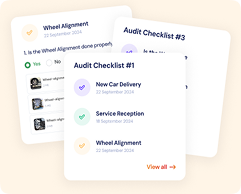
Running an operational review doesn’t need to be complex anymore. A simple garage audit checklist, performed monthly, can reveal where your business is performing well and where it’s lacking.
| Audit Area | Key Questions to Ask |
| Estimate Transparency | Do customers approve work digitally before it starts? |
| Parts & Inventory | Are any parts unbilled? |
| Technician Productivity | Are you comparing estimated vs. actual labor hours? |
| Rework Rate | Is your rework below 5% of monthly jobs? |
| Customer Experience | Are you following up with customers and gathering feedback? |
| Billing Compliance | Are invoices itemized, digital, and GST-ready? |
Consistently running through this list helps workshops benchmark performance, identify patterns, and make improvements before small issues escalate into major losses.
Benefits of Regular Auditing
Regular operational audits establish a higher standard of service and consistency across your workshop.
When you adopt a structured audit approach, you gain:
- Trust: Transparent estimates and itemized invoices eliminate customer doubt.
- Consistency: Every technician follows the same quality procedures.
- Control: You know exactly where your shop is earning or losing money.
- Culture: Your team understands that precision.
Ultimately, auditing your workshop operations builds the foundation for scalable growth. It allows you to confidently expand services or locations without losing control of quality or profitability.
Why Running on “Gut Feel” Is a Risk
In an industry driven by margins and efficiency, relying on instinct rather than data is no longer sustainable. Workshops that operate on “gut feel” often fall into predictable traps:
- Over-discounting without understanding the cost impact
- Losing money on parts already paid for
- Delivering inconsistent customer experiences
- Failing to recognize top-performing technicians or those dragging performance down
Without structured oversight, you’re managing reactively, not strategically. Data-backed digital audit systems for garages replace uncertainty with clarity, allowing owners to make informed, confident decisions.
Bringing Structure and Data to Your Workshop
You don’t need a full-time consultant or complex ERP system to start auditing effectively. What you need is a digital-first audit system that helps you:
- Track real-time performance across all ongoing jobs
- Set and enforce compliance benchmarks for every bay or location
- Identify weak spots in pricing, parts usage, and technician productivity
- Hold staff accountable with minimal manual intervention
A digital audit solution eliminates guesswork and enables a culture of continuous improvement. It’s the modern approach to running a compliant, profitable, and customer-trusted workshop.
How AutoSmart Audit Helps Garages Stay Compliant and Profitable
At AutoSmart Audit, we understand that auto repair businesses need operational visibility. Our platform is designed to help service centers, workshops, and body shops take control of compliance, consistency, and profitability.
AutoSmart Audit empowers garages to:
- Digitize Audit Processes: Move from paper checklists to intelligent, automated audit workflows.
- Enforce Standards: Ensure every service follows OEM and internal quality benchmarks.
- Visualize Compliance: Access detailed dashboards and reports to monitor performance across teams and locations.
- Improve Margins: Identify where profits are leaking whether in unbilled parts, labor inefficiencies, or rework.
By digitizing your audits, you not only enhance operational control but also build transparency with customers and staff alike.
Conclusión
With increasing regulations, customer expectations, and margin pressures, workshop operational audits are essential for survival.
Whether you manage a single garage or a multi-location network, consistent auditing is your competitive edge.
AutoSmart Audit helps service centers transform from busy to efficient by providing the digital tools to audit, monitor, and improve operations continuously.
Get a demo today and see how AutoSmart Audit is helping workshops build smarter businesses, not just busier ones.

Naseef Umar es el fundador y director ejecutivo de AutoSmart Technology, una plataforma SaaS dedicada a la digitalización de auditorías para fabricantes de equipos originales (OEM), distribuidores y redes de concesionarios. Con experiencia previa en Toyota (Abdul Latif Jameel) y formación en tecnologías de la información y gestión industrial, escribe sobre auditorías, disciplina operativa y el desarrollo de productos SaaS para clientes empresariales de distintos mercados.