
A repeat repair is one of the costliest failures in dealership aftersales operations. When a customer returns with the same unresolved issue, the dealership absorbs additional labour time, workshop capacity loss, warranty exposure, and reduced customer trust. Over time, repeated repair comebacks also affect CSI scores, technician productivity, and brand retention.
That is why many OEM networks now treat the fix it right first time programme dealership model as a core operational requirement rather than a workshop initiative. A structured FIR automotive programme focuses on improving repair accuracy, strengthening diagnostic processes, and reducing avoidable repeat visits.
For dealer principals, aftersales managers, and workshop controllers, the objective is clear: ensure every vehicle is diagnosed correctly, repaired properly, and verified before handover. Achieving a strong first time fix rate requires discipline across the full service workflow, from write-up quality to technician accountability and post-repair validation.
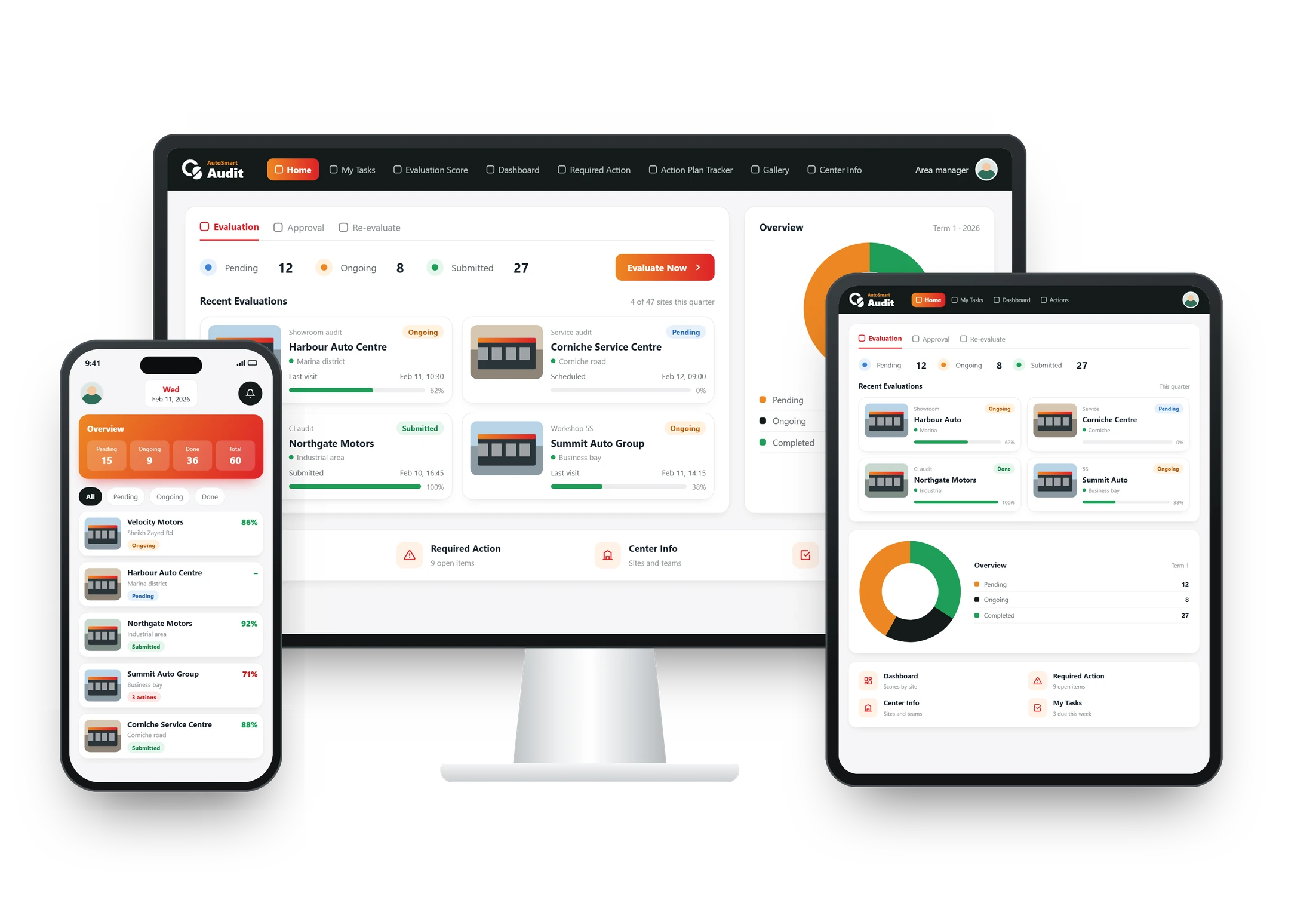
Platforms such as AutoSmart Audit help OEMs and dealer groups monitor first time fix rate performance across multiple locations, ensuring repair accuracy and warranty compliance are visible at network level.
What Is a Fix It Right First Time Programme?
A Fix It Right First Time (FIR) programme is a workshop quality management framework designed to reduce repeat repairs and improve repair consistency. The programme ensures that faults are correctly identified, repaired completely, and verified before the customer takes delivery of the vehicle.
In automotive aftersales operations, FIR automotive standards are commonly linked to OEM service frameworks, warranty controls, and field audit requirements. Many manufacturers include first time fix rate monitoring as part of dealership operational assessments because unresolved repairs create direct warranty and customer retention risks.
A successful FIR programme depends on five operational areas:
- Accurate service write-up procedures
- Structured diagnostic processes
- Technician repair quality controls
- Post-repair verification standards
- Continuous measurement and training
Without these controls, dealerships often experience recurring warranty claims, workshop inefficiencies, and declining customer confidence.
Why First Time Fix Rate Matters in Aftersales Operations
Every failed repair creates operational waste. Technicians spend additional hours reworking the same vehicle, service advisors manage customer complaints, and workshop bays become occupied with non-revenue activity.
It also affects:
- Warranty claim costs
- Customer satisfaction scores
- Technician efficiency
- Vehicle throughput
- OEM compliance performance
- Dealer profitability
For multi-location dealer networks, these issues multiply quickly across workshops.
Customers also expect higher service reliability than ever before. If a vehicle returns with the same fault shortly after repair, confidence in the dealership declines immediately. In many cases, customers choose independent workshops after repeated failed repairs.
A strong fix it right first time programme dealership strategy helps reduce these risks while improving dealership service quality across the network.
Step 1: Improve Job Card Accuracy
Many FIR failures begin before the vehicle enters the workshop. Poor write-up quality creates incomplete repair information, forcing technicians to diagnose faults without clear context.
Generic complaints such as “noise from engine” or “warning light on” provide little diagnostic direction. Service advisors must gather detailed information that technicians can use effectively.
Key Information Every Job Card Should Include
A structured job card should capture:
- Customer-reported symptoms
- Driving conditions when the fault occurs
- Whether the issue is intermittent or constant
- Previous repairs related to the complaint
- Vehicle history relevant to the issue
- Supporting photos or videos where available
Service advisors should also confirm customer concerns through active questioning rather than relying on short descriptions.
Better write-up procedures improve repair accuracy because technicians begin diagnosis with clearer information.
Why Job Card Audits Matter
Dealership groups and OEM field teams increasingly assess job card quality during operational audits. Consistent documentation standards allow network managers to identify process gaps across locations and improve warranty compliance monitoring.
Step 2: Create a Structured Diagnostic Process
A repair should never begin before the root cause is confirmed. One of the biggest causes of repeat repairs is premature parts replacement without complete diagnosis.
A structured diagnostic process creates consistency across technicians and workshops.
Core Elements of an FIR Diagnostic Protocol
An effective diagnostic process should include:
OEM Diagnostic Scanning: Technicians should complete vehicle health scans before and after repairs using approved OEM tools.
Symptom Verification: The technician must reproduce or confirm the fault before beginning repairs.
Root Cause Documentation: The symptom and the actual cause must be documented separately in the repair order.
Escalation for Complex Repairs: Recurring faults or advanced repairs should require workshop controller approval before repair authorisation.
Standard Operating Procedures Support FIR Performance
Clear workshop SOPs reduce inconsistency between technicians. Repair instructions should include:
- Step-by-step repair procedures
- Torque specifications
- Inspection checkpoints
- Testing requirements
- Quality verification standards
When technicians follow consistent procedures, dealerships improve first time fix rate performance while reducing unnecessary warranty claims.
Step 3: Introduce a Post-Repair Quality Gate
Completing a repair does not confirm that the issue has been resolved correctly. Every vehicle should pass through a quality verification stage before customer delivery.
This post-repair quality gate is one of the most important controls in a FIR automotive programme.
What the Quality Gate Should Include
Post-Repair System Scan: A final health check confirms no additional fault codes are present after repairs.
Technician Test Drive: The technician who completed the repair should verify that the original symptom no longer exists.
Secondary Inspection for Major Repairs: Complex repairs should receive additional review from the workshop controller or senior technician.
Repair Sign-Off Records: Job cards should include technician identification, timestamps, and verification signatures.
Skipping quality checks due to workshop pressure often creates avoidable repeat repairs. A dealership cannot improve dealership service quality if verification steps are inconsistent.
Step 4: Measure First Time Fix Rate Consistently
A fix it right first time programme dealership strategy only works when performance is measured continuously.
Without data, dealerships cannot identify recurring workshop failures or technician training needs.
Using AutoSmart Audit, dealer groups can track FIR KPIs, including comeback rates, technician-level performance, and audit compliance findings, in one central dashboard.
How to Calculate First Time Fix Rate
Formula: (Number of successful defect-free repairs ÷ Total repairs completed) × 100
This KPI should be monitored at:
- Technician level
- Workshop team level
- Dealer level
- Dealer group level
Tracking repair accuracy consistently allows management teams to identify patterns before warranty costs increase.
Important FIR Metrics to Monitor
In addition to first time fix rate, dealerships should monitor:
- Repeat repair frequency
- Warranty comeback rates
- Average repair cycle time
- Technician productivity
- CSI service quality scores
- Audit compliance findings
These metrics help dealerships strengthen aftersales operational excellence while improving workshop accountability.
Step 5: Use Repeat Repairs for Training Improvement
Training should be based on real workshop failure trends rather than generic classroom sessions.
When repeat repairs occur, dealerships should complete a root cause review to determine why the repair failed.
Common Causes of FIR Failure
Typical issues include:
- Incorrect diagnosis
- SOP non-compliance
- Incomplete testing
- Parts installation errors
- Lack of technical knowledge
- Communication breakdowns between advisor and technician
Once the root cause is identified, management can apply targeted corrective action.
Why Targeted Training Works Better
Blanket training programmes rarely improve repair accuracy. Workshops see stronger results when coaching is linked directly to repeat repair data and technician performance trends.
This creates measurable improvement in warranty compliance and long-term dealership service quality.
How to Measure FIR Programme Success
A successful FIR automotive programme produces visible operational improvements across the workshop.
Key indicators include:
- Reduced warranty comeback volume
- Improved first time fix rate
- Higher CSI service scores
- Lower repair cycle times
- Better technician efficiency
- Reduced field audit non-compliance findings
Most dealerships already generate this operational data daily. The challenge is organising it into measurable performance tracking systems.
Conclusion
A failed repair affects more than a single workshop visit. It impacts customer retention, technician productivity, warranty performance, and dealership profitability.
Implementing a structured fix it right first time programme dealership process allows aftersales teams to reduce repeat repairs through stronger diagnostics, better repair verification, and measurable accountability. When supported by consistent SOPs, quality gates, technician training, and operational audits, FIR programmes become part of a larger strategy for aftersales operational excellence.
For dealership groups and OEM networks, improving repair accuracy is not only about workshop efficiency. It is a long-term requirement for maintaining customer trust, controlling warranty exposure, and improving dealership service quality across every location.
Tools like AutoSmart Audit support long-term FIR programme success by standardising audits, centralising reporting, and reinforcing accountability across every dealership.