
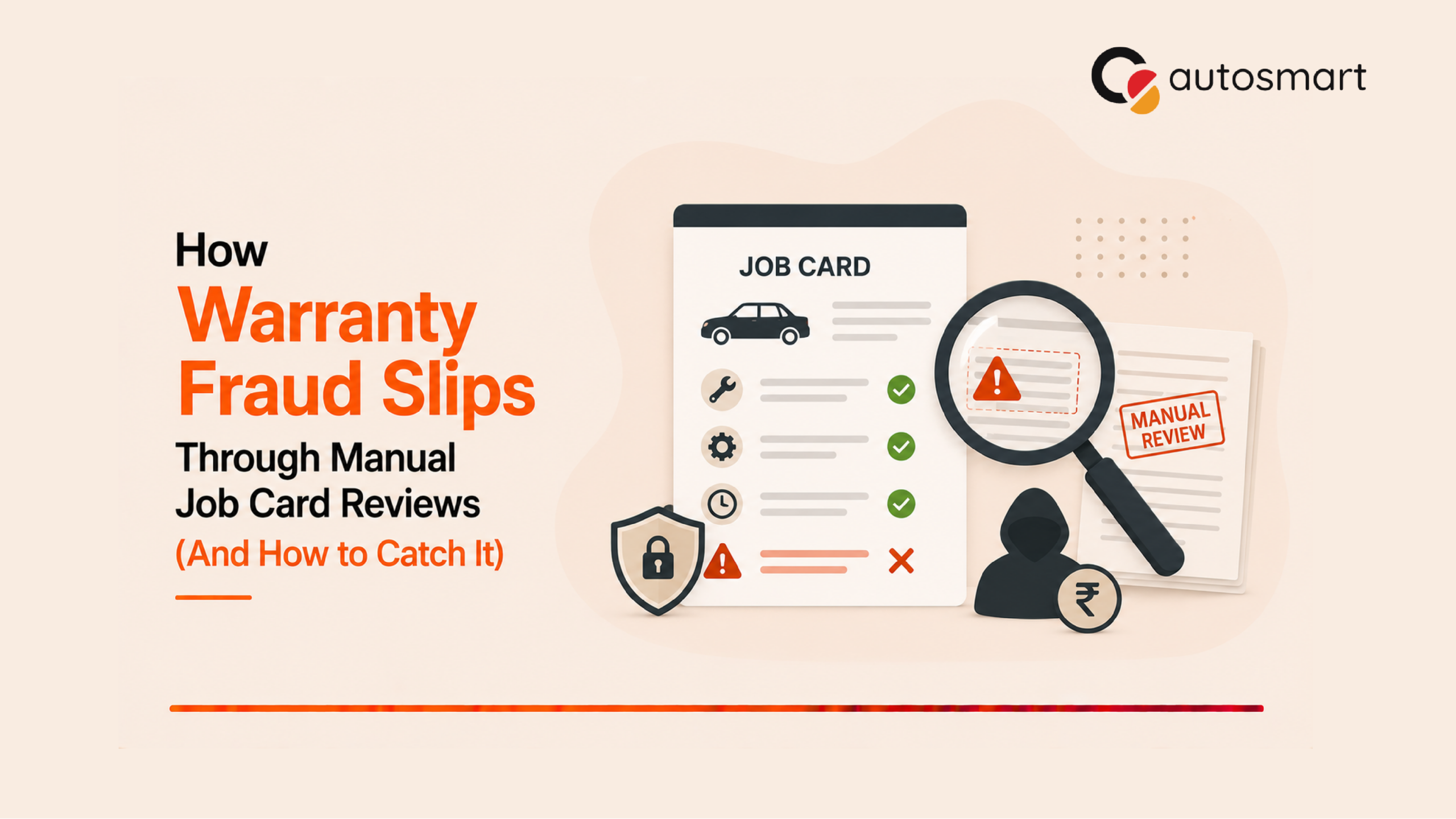
Most warranty fraud isn’t dramatic. It’s not a single obviously fabricated claim that jumps off the page — those get caught. It’s smaller and slower: a labor hour padded here, a part billed that wasn’t quite needed there, a repeat repair coded slightly differently each time so it doesn’t look like a repeat at all. Individually, each of these looks like a rounding error. Reviewed manually, one job card at a time, that’s exactly how they’re built to look.
Manual review isn’t bad at catching fraud that’s obvious. It’s structurally weak at catching fraud that’s designed to stay under the threshold of obvious — and that’s most of it.
Why Manual Review Misses What It Misses
A reviewer looking at a single job card is answering one question: does this job card look reasonable on its own? Most fraudulent job cards are built to pass exactly that test. The labor time is inflated, but not enough to trigger a second look. The part billed is plausible for the stated repair, even if it wasn’t actually used. The diagnosis and repair line up well enough on paper.
What a single-job-card review can’t do is compare this job card against the last five from the same technician, the same repair type, or the same dealership. That comparison is where the pattern shows up — and it’s exactly the layer manual review, done one card at a time, structurally skips.
The Patterns That Actually Signal Fraud
A few patterns tend to show up consistently once job cards are compared across a dealership or network, rather than reviewed one at a time:
- Labor time creep on a specific repair type: Not one inflated job, but a gradual upward drift across months, on the same operation.
- Repeat repairs coded as new issues: The same fault, addressed repeatedly, but logged under slightly different complaint codes each time to avoid looking like a comeback.
- Parts usage disproportionate to repair frequency: A part billed far more often than the repair type would statistically require, across many job cards.
- Concentration around specific technicians or PICs: Findings clustering around one or two individuals rather than spread evenly across the shop.
- Timing clusters near warranty expiry: A spike in claims for vehicles just before their warranty window closes.
None of these are visible from a single job card. All of them are visible the moment job cards get compared against each other, over time.
Why This Gets Worse, Not Better, With More Manual Reviewers
It’s tempting to think the fix is more people reviewing more job cards. It isn’t. More reviewers, each looking at job cards in isolation, doesn’t create the cross-referencing that catches patterns — it just distributes the same blind spot across more people. Two reviewers checking two job cards from the same technician, on two different days, still won’t see the pattern between them unless something ties those reviews together.
The fix isn’t more manual review. It’s a structure that carries job card history forward, so a new review is automatically checked against what came before it — not just against a general sense of what looks reasonable.
What Catches This Instead
A few mechanisms, working together, are what actually surface fraud patterns instead of individual anomalies:
- Recurrence tracking per technician and per repair type — so drift over time is visible, not buried in monthly snapshots.
- Statistical baselining on labor time and parts usage — flagging job cards that deviate meaningfully from the norm for that repair, not just ones that look wrong at a glance.
- Cross-job-card comparison at the dealership level — checking new job cards against the dealership’s own recent history, not just against a generic standard.
- Network-wide pattern visibility — so a pattern showing up at one dealership can be checked for at others, instead of staying isolated.
- Severity and confidence flagging — distinguishing a clear anomaly from a borderline one, so investigators aren’t treating every flagged item with the same urgency.
Why This Matters More as Dealer Networks Scale
For a single dealership, an experienced service manager might genuinely notice if the same technician’s jobs start running long. That instinct doesn’t scale. An OEM with 100+ dealerships generating thousands of job cards a month has no realistic path to catching drift like this through memory or spot-checks — the pattern has to be surfaced by the system, or it doesn’t get caught until it’s large enough to be obvious, which is much later than anyone would like.
The Actual Cost of Missing This
Warranty fraud that goes uncaught doesn’t stay small. A pattern that starts as a minor labor time drift, left unaddressed for a year, compounds into a meaningful line item — and it’s rarely isolated to one dealership once it’s established that a particular type of padding goes unnoticed. Catching it early isn’t just about recovering cost on individual claims; it’s about not letting a workable pattern become network behavior.

Naseef Umar es el fundador y director ejecutivo de AutoSmart Technology, una plataforma SaaS dedicada a la digitalización de auditorías para fabricantes de equipos originales (OEM), distribuidores y redes de concesionarios. Con experiencia previa en Toyota (Abdul Latif Jameel) y formación en tecnologías de la información y gestión industrial, escribe sobre auditorías, disciplina operativa y el desarrollo de productos SaaS para clientes empresariales de distintos mercados.