












Honda Clinic is Honda’s structured audit program. It checks dealership services to keep quality consistent across its global network. For dealerships in the GCC, customer expectations are high and competition is fierce. Doing well in a Honda Clinic audit is not just a compliance need; it’s also a competitive edge.
This guide explains what the Honda Clinic checks. It has a preparation checklist, a phased readiness roadmap, and explains how tools like AutoSmart Audit help GCC dealerships maintain standards between audits, not just during them.
What Does the Honda Clinic Audit Cover?
Honda Clinic evaluates a dealership across five operational areas. Understanding each one is the foundation of effective preparation.
| Audit Area | What Is Evaluated |
| Workshop Operations | Technician productivity, job card accuracy, tool availability, bay organisation |
| Customer Experience | Greeting protocol, service transparency, complaint handling, follow-up process |
| Facility Management, | Workshop and reception cleanliness, brand signage compliance, PPE usage |
| Parts Management | Genuine parts usage, inventory accuracy, billing reconciliation, ordering efficiency |
| Digital Tools & Reporting | CRM usage, DMS/ERP data accuracy, customer feedback tracking |
Each area is assessed against Honda’s predefined KPIs using a structured checklist. Dealerships receive a score per area, an overall rating, and a corrective action plan for any gaps identified.
Honda Clinic Preparation Checklist for GCC Dealerships
Use this checklist for weekly self-assessments in the lead-up to a Honda Clinic audit. It maps directly to the five evaluation areas above.
Workshop Operations
- Job cards issued promptly and accurately for every vehicle
- Technician time utilisation tracked and within targets
- Work bays organised with clearly designated tool zones
- Lift and equipment maintenance records current and accessible
- Tool calibration logs updated and available for review
- No unauthorised vehicle modifications on premises
- Work-in-progress status visible and accurately tracked
Customer Experience
- Service advisors follow the Honda greeting and intake protocol
- Costs and work scope explained to customers before work begins
- Waiting area clean, stocked, and comfortable for the climate
- Post-service handover completed with documentation
- All customer complaints logged with resolution timelines recorded
- Follow-up calls scheduled and completed after service delivery
Facility & Brand Standards
- Workshop and reception areas meet Honda cleanliness standards
- Honda signage in place, undamaged, and brand-compliant
- PPE in active use across all workshop staff during all shifts
- Safety compliance visible and documented
Parts Management
- Genuine Honda parts in use, verified at billing stage
- Inventory accuracy maintained and reconciled regularly
- Stock managed on a first-in, first-out basis
- Billing records match parts usage with no unexplained discrepancies
- Supplier invoices filed and accessible for review
Digital Tools & Reporting
- CRM updated with complete service records for every customer
- DMS/ERP data accurate and free of duplicate or missing entries
- Customer feedback collected and reviewed systematically
- Warranty-related documentation processed within required timelines
3-Phase Preparation Roadmap
Consistent Honda Clinic performance comes from weeks of preparation, not a last-minute rush. This three-phase approach works for dealerships of any size.
Phase 1: Baseline Assessment (Weeks 1-4)
Run internal mock audits using the checklist above. Score each department separately. This way, you can spot the gaps clearly. Collect baseline evidence like photos, records, and logs. This gives you a clear view of the current status. Assign a responsible person in each department to own their area’s score.
Phase 2: Training and Correction (Weeks 5-8)
Address the gaps identified in Phase 1. This usually includes refreshers for workshop staff, updated SOPs in easy-to-read formats, retraining on CRM and DMS use, and fixing facility or signage problems. Daily 15-minute team check-ins to review progress are more effective than weekly reviews for this phase.
Phase 3: Simulation and Final Readiness (Weeks 9-12)
Carry out a complete mock audit in real-world conditions. It’s best to have someone who wasn’t part of the daily prep serve as the auditor. Stress-test systems, do a deep clean of all facilities, and confirm all documentation is in order. Staff should be confident in every checklist item, not just aware of it.
Digital Audit Tools vs Traditional Methods
Many GCC Honda dealerships still rely on paper checklists or Excel sheets for internal assessments. Here is how that approach compares to a dedicated digital audit platform like AutoSmart Audit.
| Capability | Paper / Excel | AutoSmart Audit |
| Mobile access for auditors | No | Full app, works offline |
| Photo evidence linked to checklist items | Loose, unstructured | Captured and attached at point of audit |
| Corrective action tracking | Manual follow-up | Automated task assignment with deadlines |
| Reporting speed | Days to compile | Instant dashboards |
| Multi-branch visibility | No consolidated view | Unified dashboard across all locations |
| Audit history and trend tracking | Difficult to maintain | Stored and searchable |
| Checklist customisation | Requires rebuilding each time | Templates are available |
The practical difference is significant. With paper-based systems, managers often discover compliance gaps when an auditor arrives. With a digital platform, those gaps surface during internal checks weeks earlier, when there is still time to fix them.
How AutoSmart Audit Supports Honda Clinic Readiness
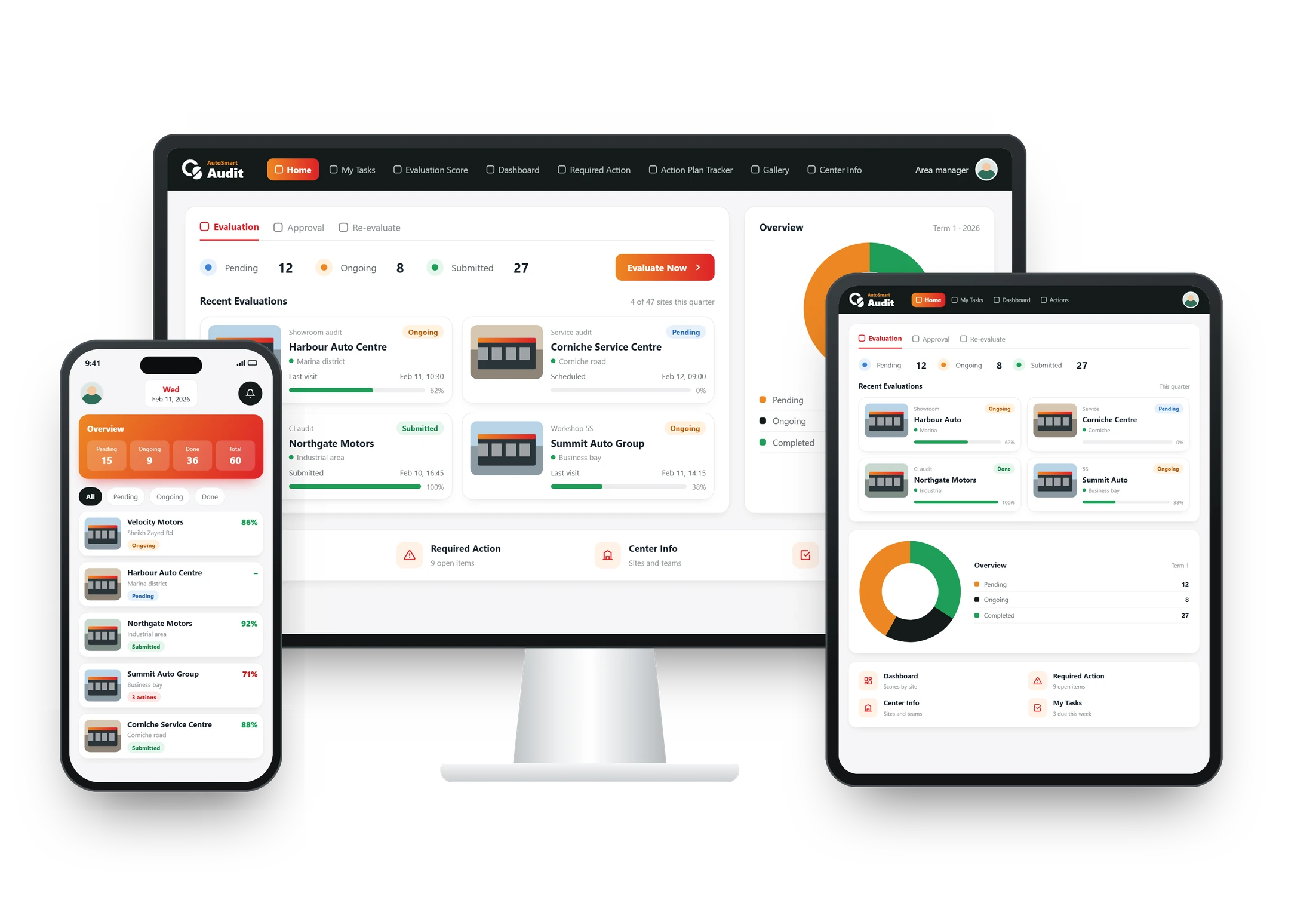
AutoSmart Audit is built specifically for automotive dealer audits. For Honda dealerships in the GCC getting ready for Clinic audits, here are some key capabilities they can use:
Customisable digital checklists can show Honda Clinic evaluation criteria across all five audit areas. You can access them from any device, even offline in workshop settings.
Capture evidence during inspection. Attach photos to the relevant checklist questions and add annotations if needed. This eliminates the time spent matching loose photos to audit reports.
Automated workflows assign tasks to the right person when a checklist item fails. They set deadlines and track how issues are resolved. They also flag items that keep failing across audit cycles.
Real-time dashboards help branch managers and regional teams check compliance status instantly at all locations. This is especially useful for dealer groups in multiple GCC countries.
Generate instant reports in formats that are great for internal reviews or sharing with Honda regional reps.
The result is a shift from just reacting to audits. Instead of preparing hard each time, we now focus on ongoing operational discipline. Now, audit-readiness is part of daily routines.
Conclusión
Honda Clinic is a high-standard audit, but it is one that any well-organised dealership can consistently perform well in. The main challenge for most GCC dealers isn’t knowing what’s needed. It’s about creating systems and habits that ensure compliance is ongoing, not just occasional.
Digital audit tools like AutoSmart Audit solve this problem. They turn a messy, stressful process into a clear, trackable, and easy part of daily work. For dealerships focused on long-term Honda Clinic performance, this shift is the most important change they can make.