A dealer network with strong products and skilled people still loses money when the processes connecting them don’t hold up. A delayed parts order keeps a vehicle in the workshop, an inconsistent service handover chips away at CSI, and a slow audit leaves corrective actions unresolved for weeks. Business process optimization is how dealer groups close those gaps systematically, rather than firefighting one branch at a time.
This guide covers what business process optimization means in automotive retail, the bottlenecks that hold dealer networks back, a practical framework for tackling them, and where digital tools fit in.
What Is Business Process Optimization in Automotive Retail?
Business process optimization means looking closely at how work actually happens, service handovers, parts ordering, audit and compliance checks, sales follow-up, and fixing the steps that cause delays, errors, or inconsistency. A single-site business can manage this informally.
Across a network of ten, twenty, or fifty branches, that approach breaks down. A process that runs fine at one site can quietly fail at another, and nobody notices until a customer complaint or an OEM audit brings it to light.
The point isn’t to shorten every process for its own sake. It’s to strip out steps that add delay or risk without adding value, then standardise what’s left. That’s what separates business process optimization from a one-off round of cost-cutting.
Common Bottlenecks in Dealership Operations
Before optimising anything, it helps to know where dealer networks typically lose time and consistency:
- Manual audit turnaround – paper-based audits that take days to compile into a usable report
- Inconsistent SOPs across branches – the same process followed differently at each site
- Parts and inventory delays – missing stock holding up repair jobs
- Siloed data – service, parts, and sales systems that don’t talk to each other
- Slow corrective action follow-up – flagged issues with no clear owner or deadline
Most dealer groups run two or three of these at once, and they compound each other. Slow audits mean slow corrective action, which lets the same issue resurface at the next check.
The Five-Step Business Process Optimization Framework for Dealer Networks
A workable process optimization framework for automotive dealer networks starts with one process and improves it systematically.
1. Map the Current Process
Document how the task actually happens today, not how the manual says it should. Speak to the people doing the work, since that’s usually where the workarounds and extra steps surface.
2. Identify the Bottleneck
Look for the point where work slows down, gets repeated, or frequently needs correcting. The biggest bottleneck isn’t always the most complicated step, it’s often a simple approval or a handoff between two departments.
3. Digitise the Touchpoint
Move the bottleneck step off paper and onto a system that captures data at the point of work. This shortens the distance between finding a problem and fixing it.
4. Standardise Across Branches
Roll out the same checklist, fields, and scoring network-wide. An improvement at one branch only creates network-level value when others can repeat it.
5. Track and Iterate
Set KPIs and revisit them monthly, since an unmeasured process drifts back to old habits. The framework compounds, each fixed bottleneck makes the next one easier to spot.
How to Optimize Dealership Operations: Where to Start
The highest-return starting points are usually the process with the most customer-facing impact, such as service handover or delivery timing, the one generating the most repeat complaints, or anything still running fully on paper.
Proving the result on one process first builds the internal case for rolling optimisation out further. A manager who can show one site’s audit turnaround cut in half gets buy-in far more easily than someone asking for a network-wide change of faith.
Reducing Audit Turnaround Time
Audit turnaround is one of the clearest levers in dealership process optimization, since a slow audit cycle delays everything downstream: corrective actions, compliance sign-off, OEM reporting.
A facility audit that takes five days on paper can often become a same-day report once scoring and evidence collection happen at the point of the check, rather than being compiled afterwards. AutoSmart’s facility activation audits have cut standard auditing and reporting time by a wide margin for dealer groups that made this shift.
Operational Efficiency Tools for Dealerships
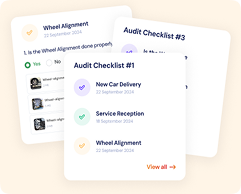
The tools that move the needle most for multi-branch dealer groups tend to share three features: digital checklists that replace paper and enforce mandatory fields, real-time dashboards that show every branch’s status without waiting on a report, and automated corrective action tracking so flagged issues have an owner and a deadline.
Having another dashboard isn’t the point. The technology should shorten the distance between finding a problem and fixing it. Our guide to dealership efficiency best practices covers the KPIs these tools should be tracking against.
Process Improvement Software: What to Look For
Not all process improvement software fits a dealer network’s constraints. Look for multi-location support, configurable checklists per department, OEM-compliant reporting, and offline mobile capability for workshop connectivity gaps.
Generic project management tools can track tasks, but they weren’t built for the audit trail and compliance needs specific to automotive retail.
How AutoSmart Supports Business Process Optimization for Dealer Networks
AutoSmart follows the same principle this framework does: find the bottleneck, digitise it, standardise it across branches, track it with real data.
Dealer groups run field audits, SOP checks, and facility inspections from mobile devices, with results feeding branch- and network-level dashboards. Our data analytics for dealer performance improvement work shows how this turns audit results into network-wide insight rather than disconnected reports.
KPIs to Track for Process Improvement
Once a process is optimised, a handful of KPIs show whether it’s actually working: audit turnaround time, corrective action closure rate, checklist compliance rate, service absorption rate (a widely used benchmark, typically 65–75% for well-run dealerships), and repeat repair rate.
Our dealer performance KPI guide goes deeper on tracking these across a network.
Getting Started with Business Process Optimization
Business process optimization isn’t a project with an end date, it’s a discipline: find the constraint, fix it, measure it, move to the next one. You don’t need every department fixed at once, and trying usually stalls the whole effort. Pick the process causing the most visible pain, fix it properly, and use the result to build momentum for the next.
AutoSmart is built to run exactly this cycle: digital checklists that standardise the fix, real-time dashboards that make the result visible across every branch, and corrective action tracking so nothing slips back to where it started. Ready to see where your network’s biggest bottleneck is costing you time? Book a demo with AutoSmart.

Ishaq leads go-to-market at AutoSmart. He spends most of his week in conversations with OEM and distributor teams about how their audit programmes actually run. He writes about network standards, rollout across markets, and building the business case for digital audits.